
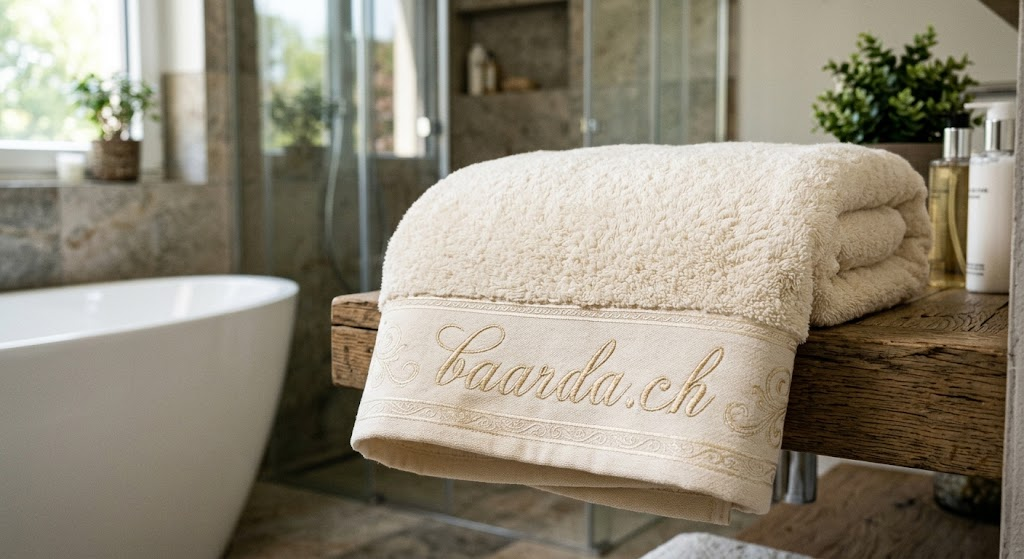
Is Polyvinyl Alcohol needed for the bathtowels, how much would it cost the baarda.ch factory per 1000 liters?
Whether Polyvinyl Alcohol (PVA/PVOH) is required for bath towel manufacturing depends on the specific towel line being produced:
- Zero-Twist & Ultra-Plush Towels (Essential): If the factory produces high-end, zero-twist cotton towels, PVA thread is required. Untwisted cotton fibers are spun around a water-soluble PVA filament to endure weaving stress. During final washing (85–90°C), the PVA dissolves entirely, leaving open, fluffy, ultra-absorbent cotton loops. Julian Charles Home
- Standard Warp Sizing (Optional / Industry Standard): In conventional terry weaving, PVA solution is applied as a protective coating on warp yarns to prevent fiber breakage on high-speed looms. While alternative starches (corn, potato, or modified starch) can be used, PVA provides film strength and easy desizing. Guangzhou Minwei PVA Sales Co., Ltd.
Estimated Cost per 1,000 Liters (Factory Scale)
Bulk industrial PVA resin (powder or granule form) trades on global markets at approximately €2.50 to €3.20 per kg.
| Solution Preparation Method | PVA Concentration | Estimated Cost per 1,000 L |
|---|---|---|
| In-House Batching (5% Light Solution) | 50 kg PVA resin in 1,000 L water | €125 – €160 |
| In-House Batching (8% Standard Sizing) | 80 kg PVA resin in 1,000 L water | €200 – €256 |
| In-House Batching (10% High Viscosity) | 100 kg PVA resin in 1,000 L water | €250 – €320 |
| Pre-Formulated Liquid Totes (IBC) | 15%–20% active liquid concentrate | €450 – €850 per tote |
If one of those towels would be in the range of 19 to 39 Franks retail price, towards which end of those prices would you go?
For a 700 GSM ELS Egyptian Giza cotton towel with low-twist yarn engineering and custom Jacquard weaving, you should price it at or near the top of that range: CHF 35 to CHF 39 for a standard bath towel (70×140 cm).
Why Pricing Near CHF 39 Makes Sense
1. Sustainable Unit Economics & Margins
- Landed Cost (COGS): Producing a 700 GSM zero-twist ELS Egyptian cotton towel with continuous air-tumbling, custom Jacquard branding, and premium packaging carries a landed cost (manufacturing + freight + customs into Switzerland) of roughly CHF 8 to CHF 12 per unit at moderate production volumes.
- CHF 19 Retail: Leaves only ~CHF 8–10 in gross margin. After accounting for Swiss VAT (8.1%), shipping, payment gateway fees (~3%), and customer acquisition costs (CAC), selling at CHF 19 would be financially unviable or unprofitable.
- CHF 39 Retail: Yields a healthy ~70% gross margin (~CHF 27+ per towel), providing the necessary buffer for digital advertising, luxury unboxing, returns, and inventory reinvestment.
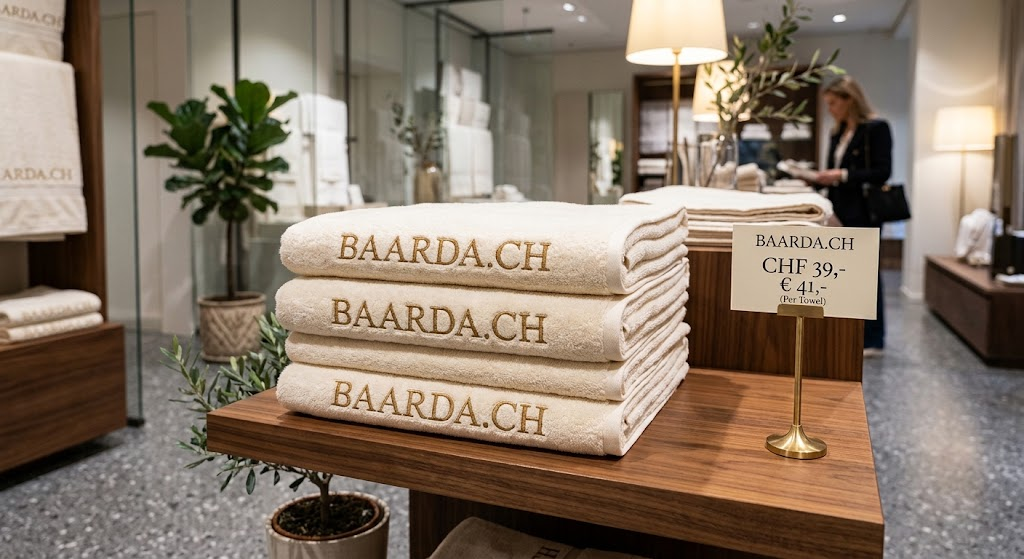
2. Swiss Market Positioning & Perceived Quality
- In Switzerland, retail prices reflect material grade. Traditional Swiss heritage brands (such as Weseta or Christian Fischbacher) sell 600–700 GSM bath towels for CHF 43 to CHF 60+.
- Pricing a 700 GSM Egyptian Giza towel at CHF 19 creates a «luxury paradox»—consumers in the Swiss market might suspect the towel uses synthetic blends or short-staple cotton, as CHF 19 aligns more closely with mass-market discount retail.
- At CHF 39, BAARDA.CH positions itself as a premium Direct-to-Consumer (DTC) alternative: offering true high-end specification at a fairer price than traditional department stores.
Recommended Tiered Price Architecture
To leverage the entire CHF 19–39 range across your product line, anchor your standard bath towel at the top end and scale by size:
| Towel Type | Dimensions | GSM | Recommended Retail Price |
|---|---|---|---|
| Standard Bath Towel | 70×140 cm | 700 | CHF 39 |
| Bath Sheet / Spa Towel | 100×150 cm | 700 | CHF 59 – CHF 69 |
Gemini: Low-twist (or zero-twist) yarn is not strictly mandatory to hit 700 GSM, but it is necessary if you want the towel to feel cloud-soft, thick, and instantly absorbent rather than stiff, dense, and canvas-like.
A 700 GSM towel made with standard high-twist yarn would be incredibly heavy, durable, and stiff—resembling a thick bath mat or heavy canvas rug—and would take much longer to absorb water because tightly twisted threads lock their fibers away from moisture. Low-twist engineering opens up those fibers to trap air and absorb water rapidly.
Low-Twist vs. Standard Twist Comparison
How Low-Twist Yarn is Engineered in the Factory
Engineering low-twist or zero-twist yarn requires a specialized five-stage process using sacrificial textile binders and Extra-Long Staple (ELS) cotton.
- Fiber Selection (Mandatory ELS Grade):
- Short or medium-staple cotton cannot be spun with low twist because short fibers slip past each other, causing the yarn to fall apart and shed excessively.
- Mills must use Extra-Long Staple (ELS) cotton (fiber lengths $>35\text{ mm}$, such as Egyptian Giza 86/92 or Supima). Long fibers naturally wrap around one another, maintaining structural integrity with minimal twisting.
- Core Spinning with PVA Binder (Sacrificial Thread):
- Because untwisted or low-twisted cotton lacks tensile strength, it cannot withstand the violent tension of industrial looms on its own.
- On the ring-spinning frame, the loose ELS cotton fibers are wrapped around a central core filament of Polyvinyl Alcohol (PVA)—a synthetic, non-toxic, water-soluble polymer.
- The PVA core acts as temporary armor, providing high tensile strength for weaving while holding the raw cotton fibers in place.
- Low-Tension Terry Weaving:
- The PVA-reinforced yarn is loaded onto the pile warp of high-speed air-jet or rapier terry looms.
- Tension controls are calibrated with higher sensitivity so the fragile pile yarn feeds into the loom without shredding.
- Continuous Thermal Dissolution (The «Unlocking» Wash):
- After weaving, the grey towel fabric moves into continuous washing and desizing ranges filled with hot water
- The PVA core completely dissolves into the water bath, leaving zero residue.
- Once the PVA binder vanishes, the cotton fibers unwind and expand to fill the void left by the dissolved core, creating hollow, micro-porous channels inside every loop.
- Hot-Air Tumbling («Loop Blooming»):
- Wet, washed towels are fed into continuous high-velocity air tumblers.
- High-pressure hot air streams forcefully separate individual cotton filaments, causing the loops to «bloom» to maximum volume, permanently setting the plush, velvety texture.
While raw Extra-Long Staple (ELS) Egyptian Giza cotton and heavy textile machinery form the physical foundation, producing a 700 GSM BAARDA.CH towel requires a complete industrial ecosystem that spans chemical engineering, custom software, energy management, and regulatory certification.
The 5 Pillars Required Beyond Bales & Hardware
- Chemical Inputs & Sacrificial Polymers:
- Raw cotton cannot be woven directly; it requires Polyvinyl Alcohol (PVA) yarn core binders for low-twist strength, bio-based cornstarch sizing, non-toxic soda ash or enzyme scouring agents to strip natural waxes, and OEKO-TEX certified reactive dyes for vibrant, bleed-proof color fastness.
- Specialized Industrial Machinery Chain:
- An operational line isn’t just one room of machines; it requires six distinct, capital-intensive equipment zones:
- Spinning: Fine-tooth combers and PVA ring-spinning frames.
- Weaving: High-speed rapier/air-jet looms equipped with electronic Jacquard shedding heads.
- Wet-Processing: Continuous desizing, bleaching, and tensionless jet-dyeing vessels.
- Finishing: High-velocity continuous air-tumblers (for loop blooming).
- Conversion: Automatic optical cutting, double-needle side-hemming, and cross-fold stitching units.
- An operational line isn’t just one room of machines; it requires six distinct, capital-intensive equipment zones:
- High-Volume Water Treatment & Energy Infrastructure:
- Wet finishing, PVA dissolution, and reactive dyeing require thousands of liters of purified (softened) water per batch to prevent mineral staining on light cotton fibers. Factories require dedicated Reverse Osmosis (RO) filtration systems and an on-site Effluent Treatment Plant (ETP) to neutralize and recycle dye wastewater.
- Digital Jacquard Programming & Technical Expertise:
- Software engineers must translate the BAARDA.CH branding and script typography into pixel-by-pixel electronic loom files (EP files). Master dyers must formulate precise color recipes, and loom technicians must finely calibrate warp tension so fragile low-twist threads do not snap under high-speed operation.
- Certification & Traceability Audits:
- Claiming «Egyptian Giza» on a luxury brand requires formal DNA-testing certification from the Cotton Egypt Association (CEA) to verify purity against cheaper short-staple cotton blends, along with OEKO-TEX Standard 100 certification to guarantee the towel is free of harmful residues.
Raw Egyptian Giza cotton itself is a 100% natural plant fiber harvested from cotton plants along the Nile Delta. However, converting raw, harvested cotton into a soft, absorbent, brightly colored BAARDA.CH luxury towel requires specific chemical treatments during the manufacturing process.
If you tried to make a towel straight out of raw harvested Giza cotton without chemical wet processing, it would actually repel water, feel stiff, look yellowish-grey, and shed constantly.
Key Chemical Inputs in the Factory Line
- Polyvinyl Alcohol (PVA Yarn Binder): During low-twist yarn spinning, a water-soluble synthetic polymer called PVA is wrapped around the fragile cotton fibers. It acts as temporary scaffolding so the loose cotton threads don’t snap under high-speed loom tension. Once woven, the fabric passes through an $80\text{–}90\text{°C}$ hot water bath where the PVA completely dissolves into liquid, leaving pure, fluffy cotton loops behind with zero chemical residue on the finished towel.
- Enzymatic Desizing: Before weaving, warp yarns are coated with starches (sizing) to withstand loom friction. In the finishing line, natural amylase enzymes are added to break down these starches so they wash out easily.
- Alkaline Scouring (Unlocking Water Absorbency): Raw cotton fibers are naturally coated in hydrophobic plant waxes, pectins, and natural oils that protect the plant from rain. Scouring treats the raw fabric in a mild sodium hydroxide or bio-enzyme bath to dissolve these waxes. Without scouring, water would simply bead up and roll off the towel.
- Hydrogen Peroxide Bleaching: Raw cotton is naturally off-white or yellowish-grey. Universal bleaching agents like hydrogen peroxide break down natural plant pigments to create a pristine white base without degrading the delicate Egyptian cotton fibers.
- Reactive Dyeing & Chemical Fixing: To produce custom towel colors, reactive dyes are introduced alongside alkali salts. Reactive dyes form direct chemical bonds with the cotton’s cellulose molecules, ensuring the dye remains fast and will not bleed or fade during hot home laundry cycles.
- Bio-Softening Finishes: In the final rinse, bio-based cationic or silicone softeners are applied to lubricate individual filaments, giving the loops their velvety softness and preventing static.
OEKO-TEX Safety Certification
For a high-end luxury brand like BAARDA.CH, factories run the towel through multiple continuous hot-water rinsing cycles at the end of the line. Independent certifications like OEKO-TEX Standard 100 test the finished towel to guarantee that all processing chemicals, alkalis, and heavy metals have been completely washed away, making the towel 100% safe for direct skin contact.
Reint Jelger: Gem, you are saying to get these towels normal baarda.ch would also need to do: Hot-Air Tumbling («Loop Blooming») is that strictly neccesary?
Gemini: Strictly speaking, no—it is not physically mandatory to produce a functioning piece of woven cotton fabric. If you skip hot-air tumbling, the towel will still dry and hold together.
However, for a 700 GSM low-twist luxury towel, skipping this step fundamentally alters the product. Without hot-air tumbling, you lose the signature plush volume and soft hand-feel out of the package.
What Happens If You Skip Hot-Air Tumbling?
- The Towel Arrives Flat and Board-Stiff: After wet processing, dyeing, and washing out the PVA binder, wet cotton loops lie flat, twisted, and matted against the ground fabric. If dried on standard industrial heated cylinders or tension-driven drying frames, the loops freeze in this flattened state.
- 20%–30% Loss in Visual Volume (Loft): A 700 GSM towel derives its luxury appeal from height and air space between loops, not just physical weight. Without air tumbling, the towel looks like a dense, heavy floor mat or canvas sheet rather than a deep, plush spa towel.
- Puts the «Blooming» Burden on the Customer: If you skip industrial tumbling, the loops will eventually unflatten and bloom—but only after the customer washes and tumble-dries the towel 2 to 3 times in their home laundry. Selling a premium towel that feels stiff and flat upon unboxing damages initial consumer perception.
How Factories Handle It Without Continuous Air Tumblers
If a textile mill lacks a continuous high-speed hot-air tumbler (such as a Biancalani or Thies continuous air relaxer), they use alternative methods:
- Batch Industrial Tumble Dryers: Large-capacity commercial tumble dryers achieve the same loop-blooming effect as continuous systems. However, processing towels in batches increases production time, energy consumption, and labor costs.
- Steam Relaxing Chambers: Some mills pass the fabric through tensionless steam relaxation tunnels, though steam alone provides less mechanical agitation to lift dense, heavy 700 GSM loops compared to high-velocity hot air streams.
For a brand positioned like BAARDA.CH, ensuring the towels undergo proper tensionless hot-air tumbling (either continuous or batch) is essential to deliver that instant, cloud-like loft right out of the box.
1.Fiber Selection & Combing:
Fiber length. 35mm required
Select premium Extra-Long Staple (ELS) organic cotton (such as Egyptian Giza 86/92 or Suvin). Pass raw cotton through fine-tooth combing machines to remove short fibers under 25mm, leaving only long, uniform fibers that prevent pilling and lint formation.
2.Zero-Twist / Low-Twist Ring Spinning:
Spin the combed fibers into pile yarns using a water-soluble Polyvinyl Alcohol (PVA) core binder. Zero-twist or low-twist spinning leaves individual cotton filaments untwisted, creating hollow, air-trapping loops that deliver maximum absorbency and a cloud-like texture.
3.Warping & Eco-Sizing:
Wind thousands of warp ends onto beaming spools under equal tension. Apply a bio-based, easily washable sizing agent (cornstarch or PVA) to protect the ground warp threads against high friction during high-speed loom insertion.
4.High-Speed Jacquard Terry Weaving:
Feed three distinct yarn systems—ground warp, pile warp (top and bottom loops), and weft—into air-jet or rapier terry looms. Electronic Jacquard shedding controls individual pile yarns to weave custom BAARDA.CH logos, border textures, or relief patterns directly into the towel hem and pile.
5.Desizing, Scouring & Eco-Bleaching:
Pass the woven grey fabric through continuous washing ranges to dissolve all sizing agents and natural cotton waxes. Apply hydrogen peroxide bleaching at controlled pH and temperature to create a clean, uniform white base with neutral absorbency.
6.Low-Impact Dyeing & Bio-Softening:
Dye the fabric using low-impact, OEKO-TEX certified reactive dyes that chemically bind to the cellulose fibers for high colorfastness. In the final rinse, apply cationic or bio-silicone softeners to seal fiber smoothers without impairing water absorption.
7.Continuous Air Tumbling & Drying:
Crucial for loop blooming. Feed wet towels into a continuous high-velocity air tumbler. High-pressure air streams relax yarn stress from weaving and forcefully open («bloom») the zero-twist terry loops, giving the fabric its maximum volume and loft.
8.Automated Longitudinal & Cross Hemming:
Feed fabric rolls into automated towel conversion lines. Precision optical sensors position cuts, followed by double-needle lockstitching on side hems and high-density flat folding on end hems to prevent unraveling over hundreds of wash cycles.
9.Inspection, Labeling & Packaging:
Run finished towels through needle detectors, optical thread trimmers, and manual GSM weight checks. Sew woven BAARDA.CH satin care labels into the cross hem before folding and eco-friendly band-wrapping for presentation.