
Google Gemini: Combining liquid beverage production (canned iced coffee) and cosmetics/personal care (deodorant) in one industrial setup creates an interesting dual-production dynamic.
Here is how the iced coffee production process works, followed by the steps and estimated costs for securing industrial land in Sneek.
Part 1: Production Process for Canned Iced Coffee («SneeIIsCofje»)
To manufacture ready-to-drink (RTD) iced coffee in aluminum cans safely and efficiently at scale, your facility must follow a strict, automated linear process:
1. Water Treatment & Ingredient Dosing
- Water Purification: Water makes up over 80% of the beverage. It must pass through reverse osmosis (RO) systems and UV sterilizers to ensure strict consistency and taste.
- Extraction/Brewing: Depending on your recipe (cold brew or thermal espresso-base), high-capacity industrial extraction tanks extract the coffee solids.
- Mixing & Emulsification: In jacketed mixing tanks, coffee extract is combined with milk or plant-based alternatives, sweeteners, and stabilizers (e.g., dipotassium phosphate to prevent dairy curdling during thermal processing).
2. Homogenization & Pasteurization
- Homogenization: High-pressure homogenizers break down fat globules in milk so the liquid remains uniform and doesn’t separate in the can over time.
- Pre-Heat Treatment: HTST (High Temperature Short Time) pasteurization stabilizes the mixture before canning.
3. Canning Line (Depalletizing, Filling & Seaming)
- Depalletizing & Rinsing: Empty aluminum cans are unstacked, inverted, and rinsed with sterile water or air-purged.
- Isobaric Filling: An automated rotary filler charges the cans with liquid under nitrogen dosing (or CO2 depending on carbonation level). Liquid nitrogen drops are often used in non-carbonated beverages to displace oxygen (extending shelf life) and create internal pressure for can rigidity.
- Seaming (Seamer): Can lids (ends) are mechanically double-seamed onto the filled bodies to form a hermetic seal.
4. Thermal Sterilization (Retort Autoclave)
Because dairy-based coffee is a low-acid beverage (pH > 4.6), it is highly susceptible to spore-forming pathogens like Clostridium botulinum.
- Sealed cans must pass through a retort sterilizer (high-pressure batch or continuous steam autoclave) at ~121 °C (250 °F) for a calculated dwell time. This ensures shelf-stability at room temperature without preservatives.
5. Code Printing, Drying & Secondary Packaging
- Cans are batch-coded via continuous inkjet (expiry date, lot number), air-dried, inspected with inline vision systems (fill level & seam check), wrapped in tray-shrink packs or cardboard cartons, and automatedly palletized.
Part 2: Land Acquisition & Industrial Real Estate in Sneek
Finding Industrial Land in Súdwest-Fryslân
The Municipality of Súdwest-Fryslân controls municipal plot issuances on primary industrial parks in Sneek, such as De Hemmen (e.g., De Hemmen 3), Houkesloot, and Oosterom.
To acquire a suitable plot:
- Contact Municipal Economic Affairs (Accountmanager Bedrijven Súdwest-Fryslân): Municipalities directly sell new industrial plots. They evaluate your project based on employment creation, sustainability score (e.g., wegingsmatrix duurzaamheid), and environmental impact. Gemeente Súdwest-Fryslân
- Commercial Real Estate Brokers (Bedrijfsmakelaars): Brokers active in Friesland (such as RBMT, Hooijer, or Van der Wal) list existing plots or resale industrial land.
- Funda in Business & Government Portals: Check
sudwestfryslan.nlfor municipal releases and Funda in Business for private commercial resales. Gemeente Súdwest-Fryslân
Environmental Zoning Considerations (Important for Dual-Use)
Combining a beverage factory (food grade – HACCP / IFS / BRC certified) and a deodorant factory (cosmetics / chemical formulation) requires strict structural segregation:
- Zoning (Omgevingsplan / Bestemmingsplan): The land must allow Category 3.1 or 3.2 industrial activities (milieucategorie).
- Physical Isolation: Your architect must design two completely segregated halls with independent HVAC, drainage, and air-handling systems so aerosol propellant/fragrance chemicals cannot cross-contaminate food production areas.
Land Costs in Sneek (2026 Benchmarks)
Industrial land pricing in Sneek varies based on highway visibility (e.g., along the N7) versus internal industrial estate positioning:
| Location Type | Price Range per m² (excl. VAT / excl. btw) | Notes |
|---|---|---|
| Standard Industrial Plot (Middenterrein / Oosterom) | €88 – €95 / m² | Suitable for core production facilities and logistics hubs. |
| Prime Highway Visibility (Zichtlocatie N7 / De Hemmen) | €90 – €118 / m² | Premium plots with high brand exposure. |
Budget Estimate for a Dual-Production Site
A small-to-medium factory capable of housing both lines, storage, loading docks, and administration typically requires a minimum plot size of 2,500 m² to 5,000 m²:
Gemeente Súdwest-Fryslân
- 2,500 m² plot (Standard): ~€220,000 to €235,000 (excl. VAT) Gemeente Súdwest-Fryslân
- 2,500 m² plot (Prime Visibility): ~€295,000 (excl. VAT) Gemeente Súdwest-Fryslân
- 5,000 m² plot (Standard): ~€440,000 to €475,000 (excl. VAT)
Grid Capacity Note: Súdwest-Fryslân industrial parks have specific power-grid connection constraints. Ensure you apply early for a high-capacity grid connection (kleinverbruik 3x80A or grootverbruik) as wait times for grid expansions can take up to 1–2 years depending on the location.
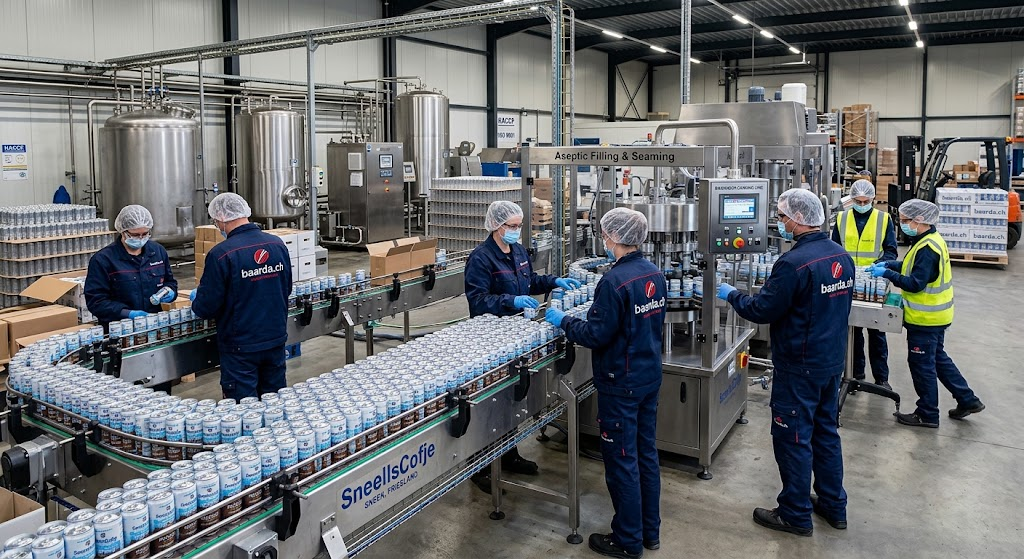
Gemini: Here is a breakdown of what is happening on the factory floor and the role of the industrial equipment shown in the image.
What the Workers Are Doing
The team is operating an automated canning and packaging assembly line:
- Inline Inspection & Quality Control (Foreground Center):
- Workers stationed along the conveyor belt manually inspect filled cans of SneellsCofje as they pass through. They are verifying liquid levels, checking lid integrity, and ensuring proper alignment before the cans head to final packaging.
- Canning Line Monitoring (Center Right):
- A line operator works directly at the automated filling unit control panel (HMI touch screen). They monitor line speed, pressure levels during the filling process, and sealing metrics to maintain consistent seam seals.
- Secondary Packaging & Tray Loading (Far Right):
- Workers at the end of the line take finished, inspected cans and load them into secondary packaging (cardboard shipping trays and shrink-wrapped bundles) stacked onto pallets for warehouse transport.
- HACCP & Hygiene Compliance:
- Everyone is wearing food-grade personal protective equipment (PPE)—including hairnets, face masks, blue nitrile gloves, and uniform overalls—to comply with strict HACCP (Hazard Analysis Critical Control Point) hygiene protocols for dairy and beverage production.
What the Big Metallic Tanks in the Background Are
The vertical stainless-steel vessels in the background are sanitary processing and storage tanks, essential for ready-to-drink (RTD) coffee production:
- Jacketed Batch Mixing Tanks:
- Tanks equipped with top-mounted agitator motors blend coffee extract, water, milk or plant-based bases, and sweeteners under temperature-controlled conditions. The double-wall «jacket» allows hot or cold liquid to circulate around the vessel wall, maintaining consistent temperatures before canning.
- Buffer / Holding Tanks:
- Once a batch of iced coffee is homogenized and pasteurized, it moves into sanitized holding tanks. These feed the canning line at a constant pressure and rate, ensuring the filler operates continuously without needing to pause between brewing cycles.
- CIP (Clean-in-Place) Storage Tanks:
- Larger stainless-steel tanks in beverage plants store cleaning solutions (caustic and acid rinses) and sterile rinse water. These automatically flush, clean, and sanitize the internal piping and filler heads between production runs without taking the machinery apart.