
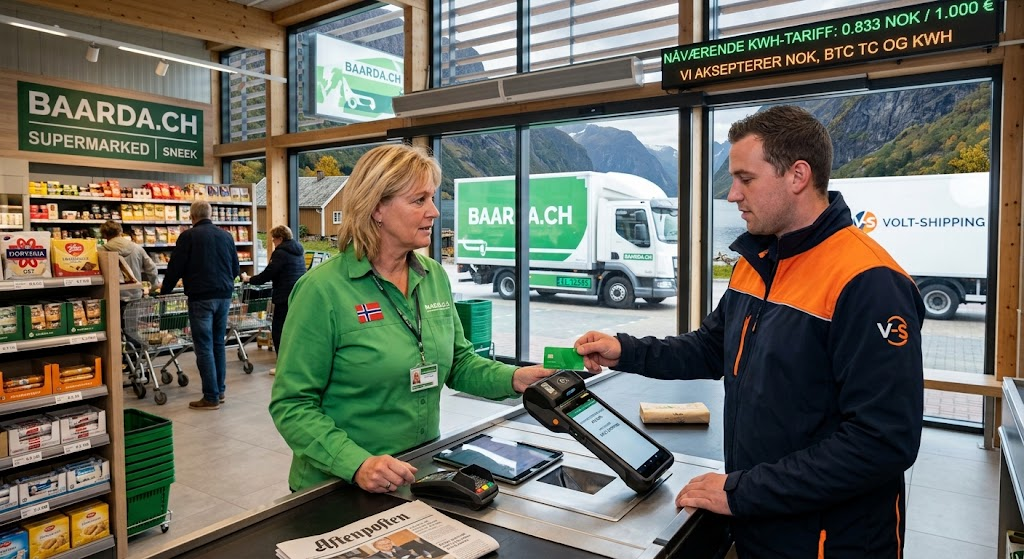
Here I tried to render a picture of a society where a 3 currency idea would be active. A Baarda.ch supermarket making a electricity payment to a delivery company. Then I tought lets make a image of three currencies, here it is, with this one it looks a bit like the illuminati will use euro’s mainly, just a joke, but here it is:
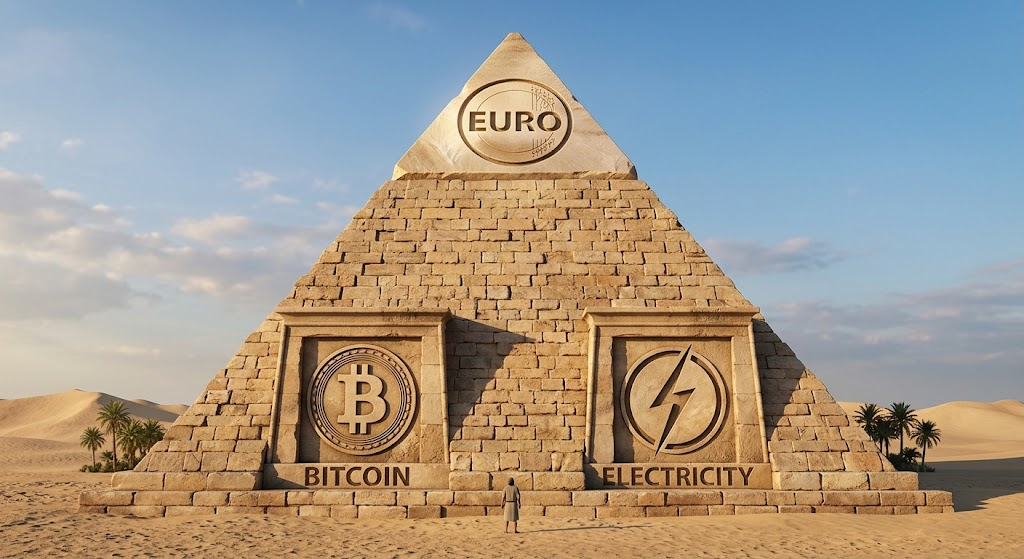
Google Gemini: A tri-monetary model like this—where a national fiat currency, a borderless digital asset, and a physical utility-backed unit operate side-by-side—is a fascinating thought experiment. To envision how society might actually function under a 33/33/33 dynamic, we have to look at what happens when three fundamentally different concepts of value share the burden of everyday commerce.
Here is how such an ecosystem could work, how each asset would find its niche, and the practical dynamics of «spritty spritty» (splitting economic activity equally three ways).
1. The Division of Roles: How the Three Monies Coexist
Money generally serves three primary functions: a medium of exchange, a unit of account, and a store of value. In a tri-monetary system, each of your three currencies naturally dominates the function it handles best:
- Norwegian Kroner (NOK) — The Institutional & Local Anchor: NOK provides stability for local economic contracts. Because taxes, municipal services, public wages, and legal judgments are denominated in NOK, it remains the ultimate unit of account for domestic life. It handles fixed local costs where price predictability is essential, such as residential rent, court fines, and state pensions.
- Bitcoin (BTC) — The Global & Sovereign Reserve: Bitcoin serves as the un-confiscable, long-term store of value and cross-border settlement layer. Free from geographic boundaries and central control, it handles high-value international trade, digital commerce, capital preservation, and inter-agent transfers that require absolute neutrality and finality without banking intermediaries.
- Electricity / Kilowatt-Hours (kWh) — The Thermodynamic & Productive Unit: An electricity-backed unit (often conceptualized as a standard measure of energy, such as a localized 1 kWh token or grid credit) is the ultimate commodity currency. Unlike fiat or Bitcoin, electricity has direct physical utility: it powers industry, warms homes, and drives computational infrastructure. It grounds the financial system in real-world physics, acting as a dynamic unit of trade between energy producers, industrial consumers, and automated systems.
2. What a 33% / 33% / 33% Society Looks Like in Practice
For society to maintain an equal balance across all three, economic actors would naturally align transactions with the unique strengths of each medium:
| Dimension | Norwegian Kroner (33%) | Bitcoin (33%) | Electricity (kWh) (33%) |
|---|---|---|---|
| Primary Use Case | Local taxes, public services, retail, state contracts | Wealth preservation, global trade, cross-border payments | Industrial production, data centers, heating/charging |
| Underlying Value | Backed by the Norwegian state, law, and tax baseline | Backed by mathematical scarcity & global consensus | Backed by physical energy, thermodynamics, & immediate utility |
| Core Advantage | Low volatility, local legal tender status | Censorship-resistant, fixed supply, infinite portability | Intrinsic physical demand, perfectly inflation-resistant to energy costs |
Daily Commerce and Payments
In a multi-currency payment terminal at a local store, smart POS systems would automatically settle trades according to live floating exchange rates.
- You might pay for your daily groceries in NOK or small Bitcoin fractions (via the Lightning Network).
- You might pay your vehicle charging, home heating, server hosting, or industrial hardware bills directly in kWh tokens.
- Merchants could accept payment in whichever unit fits their immediate operational balance sheet (e.g., a bakery accepting kWh credits directly to offset its high oven electricity bills).
Energy as the Bridge
The most compelling synergy in your model is the relationship between Electricity and Bitcoin:
- Electricity can be directly converted into Bitcoin through mining.
- Bitcoin can be sold on global markets to finance renewable energy infrastructure (hydro, wind, solar).
- Surplus grid capacity—which would otherwise be wasted during off-peak hours—is immediately tokenized or monetized, turning energy producers into central financial nodes.
3. The Structural Challenges of Equal Coexistence
While the concept creates a balanced system backed by law (NOK), math (BTC), and physics (kWh), maintaining a strict 33% split introduces key structural dynamics to consider:
- Gresham’s / Thiers’ Law Dynamics: Historically, when multiple currencies circulate, people tend to hoard the «hardest» money (the one that retains value best over time, like Bitcoin or Energy) and spend the «softest» or most inflatable money (fiat). To maintain an equal 33% split in active usage, legal frameworks or smart-contract incentives would need to encourage circulating all three rather than hoarding one.
- Volatility and Real-Time Exchange: Electricity values vary based on season, weather, and grid demand, while Bitcoin experiences market cycles, and NOK fluctuates with interest rates and oil/gas markets. A seamless tri-currency society relies heavily on automated «behind-the-scenes» routing where software instantly converts units at the point of sale so individuals don’t have to calculate complex conversion rates manually.
- Storage and Perishability: While Bitcoin and NOK can be held digitally indefinitely without physical decay, electricity storage (batteries, pumped hydro, thermal storage) has physical constraints and decay over time. Therefore, an electricity currency functions primarily through digital «grid credits» redeemable for power, tied directly to generation and storage capacity.
Summary
Envisioning a society built on this triad moves money away from a single centralized monopoly and into a three-pillar ecosystem:
- Law (NOK for social contracts and taxation)
- Mathematics (Bitcoin for sovereign digital property)
- Physics (Electricity for tangible thermodynamic value)
In such a system, trade is anchored simultaneously in civic institution, global digital consensus, and the fundamental energy that powers human civilization.