
Gemini: Skanska AB is a prominent choice. Founded in 1887, it is one of the world’s largest construction and project development multinationals, headquartered in Stockholm, Sweden.
Other notable options include:
- Peab AB: Known as «the Nordic Community Builder,» focused heavily on large-scale infrastructure, civil engineering, and regional construction across the Nordics. Neuroject
- NCC AB (Nordic Construction Company): A major player specializing in complex commercial property development, infrastructure, and sustainable building solutions. Neuroject
- JM AB: One of the leading developers and builders of residential housing in Sweden and the Nordic region. CompanyData
Reint Jelger: Like If I would want to have a skyscraper build in Luzern, could I use Skanska AB for that?
Gemini: Not directly in practice.
Technically, Skanska has the engineering capabilities and experience to construct high-rise buildings worldwide, but Switzerland is not one of their active geographical markets. Skanska concentrates its European operations primarily in Sweden, Norway, Finland, the UK, Poland, the Czech Republic, and Slovakia. They do not operate a local Swiss branch or hold a active construction presence in Lucerne.
If you were developing a skyscraper in Lucerne, you would typically hire major domestic Swiss general contractors or European construction giants active in Switzerland:
- Implenia AG: The largest construction and real estate services company in Switzerland, headquartered in Opfikon. They handle large-scale Swiss high-rise developments.
- Anliker AG: A prominent local builder rooted directly in the Lucerne/Central Switzerland region with massive civil engineering and building capacity.
- HRS Real Estate AG: A major Swiss general contractor specializing in complex, high-volume commercial and residential projects across Switzerland.
- Marti Holding AG: One of the top Swiss construction groups capable of executing large-scale structural projects.
Furthermore, building a skyscraper in Lucerne involves strict local zoning regulations, historic city protection laws, and height restrictions governed by the canton and municipality, making local Swiss contractors the standard choice for navigating the regional regulatory landscape.
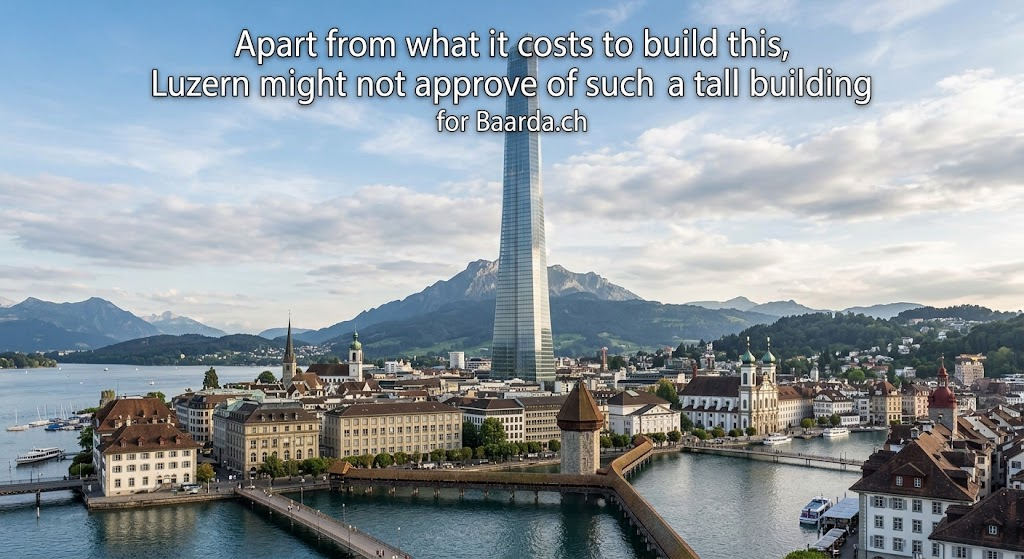
Reint Jelger: Could you tell me about height restrictions in and around Luzern, because I want to build a 840 meter skyscraper in Luzern
Gemini: An 840-meter skyscraper (which would be taller than the Burj Khalifa at 828 m) faces significant regulatory, geographical, and legal hurdles in Lucerne.
Here is an overview of height restrictions and planning framework in and around Lucerne:
1. The Municipal Building and Zoning Regulations (BZO)
- Strict Zone Limits: The City of Lucerne and surrounding municipalities dictate maximum building heights via their Bau- und Zonenordnung (BZO). Standard urban residential zones (W2–W5) generally cap heights around 2 to 5 full storeys (roughly 7 to 16 meters).
- High-Rise Concept (Hochhausreglement): Lucerne has explicit high-rise concept plans (Hochhausleitbild). High-rise status generally applies to buildings exceeding 22 to 30 meters.
- Designated Clusters: Tall structures are strictly confined to specific development zones—typically around key transit hubs outside the historical core, such as Luzern South (Kriens/Mattenhof) or Rothenburg—and even in these areas, «high-rise» usually tops out around 60 to 88 meters.
2. Heritage Protection and Visual Landscape Standards
- Historic Preservation: The historic center of Lucerne (including the Chapel Bridge, Musegg Wall, and old town skyline) is strictly protected under municipal and cantonal heritage laws. High-rise developments cannot disrupt historical sightlines or iconic views of Mount Pilatus and Lake Lucerne.
- Shadow and Setback Laws: Under Swiss planning law, building setbacks scale with building height to prevent blocking sunlight to neighboring properties. A tower of 840 meters would cast a shadow spanning kilometers across Lake Lucerne and neighboring cantons, violating basic Swiss residential spacing and light access standards.
3. Federal and Environmental Planning Constraints
- Federal Spatial Planning Act (RPG): Swiss national law emphasizes dense, low-to-mid-rise urban development and protection of non-buildable agricultural/alpine landscapes.
- Aviation Regulations (BAZL): The Federal Office of Civil Aviation regulates tall structures. An 840-meter building would severely enter controlled airspace for regional air traffic, emergency medical flights (REGA), and nearby military airfields (such as Emmen Air Base).
Real-World Context in Switzerland
- Tallest Building in Switzerland: The Roche Tower 2 in Basel stands at 205 meters, currently the tallest inhabited building in the country.
- Kriens/Lucerne Region: The tallest high-rise in the immediate Lucerne metro area is the Aaguturm / Pilatus Tower development area in Kriens, standing under 90 meters.