Google Gemini: Yes, the Dutch did indeed invent the modern stock market, but the idea that the Danish are «doing it too» depends on whether you mean historical architecture, contemporary finance, or a clever nod to history.
Here is how the history and the connection play out:
1. The Dutch Roots (The First Stock Market)
The credit firmly goes to the Netherlands of the early 17th century. Following the establishment of the Vereenigde Oostindische Compagnie (VOC)—the Dutch East India Company—in 1602, the company issued transferable shares to the public to raise capital for its massive trading voyages.
Beurs van Berlage
To let investors buy and sell these shares easily after the initial issuance, a secondary market emerged in Amsterdam—centered first around the Nieuwe Brug and later formalized in exchanges like the Beurs van Hendrick de Keyser. This gave birth to the world’s first official, continuous, and liquid stock market.
2. The Danish Connection (Børsen and King Christian IV)
Denmark actually has a remarkably close chronological and architectural link to this history, which might be what prompts the thought about the Danish «doing it too»:
- The Inspiration: King Christian IV of Denmark (who ruled from 1588 to 1648) was heavily inspired by Dutch mercantile success and trade innovations.
- Building Børsen: Between 1619 and 1624, Christian IV commissioned the construction of Børsen (the Old Stock Exchange) in the heart of Copenhagen. Designed in the Dutch Renaissance style, it featured merchant stalls on the ground floor and served as a bustling commercial hub. Visit Copenhagen
- From Goods to Securities: While Børsen started primarily as a commodity exchange (trading everything from spices and textiles to fish and cheese), it gradually evolved into a marketplace for securities and bonds in the 19th century before modern electronic trading took over.
(Note: If you’ve heard news about Børsen recently, it tragically made international headlines in April 2024 when a massive fire destroyed a large portion of the historic 400-year-old building, though restoration efforts are currently underway).
Summary
The Dutch invented the concept of public joint-stock companies and continuous stock trading in 1602. Neighboring Denmark adopted the physical and institutional framework of a national exchange very shortly afterward under Christian IV—borrowing heavily from the Dutch blueprint to boost their own Nordic trade network.
Are you looking into how early modern corporate law and financial instruments evolved across the North Sea and the Baltic, or tracking a specific modern financial development between the two regions?
Reint Jelger: What is the address of the Danish Stockmarket, and how is it called, like Euronext too, or like Nasdaq?
The modern Danish stock market is named Nasdaq Copenhagen. Rather than following the Euronext model, it belongs to the Nasdaq family—specifically operating under Nasdaq Nordic, which links exchanges across Sweden, Finland, Denmark, and the Baltic states. Its modern corporate headquarters is located
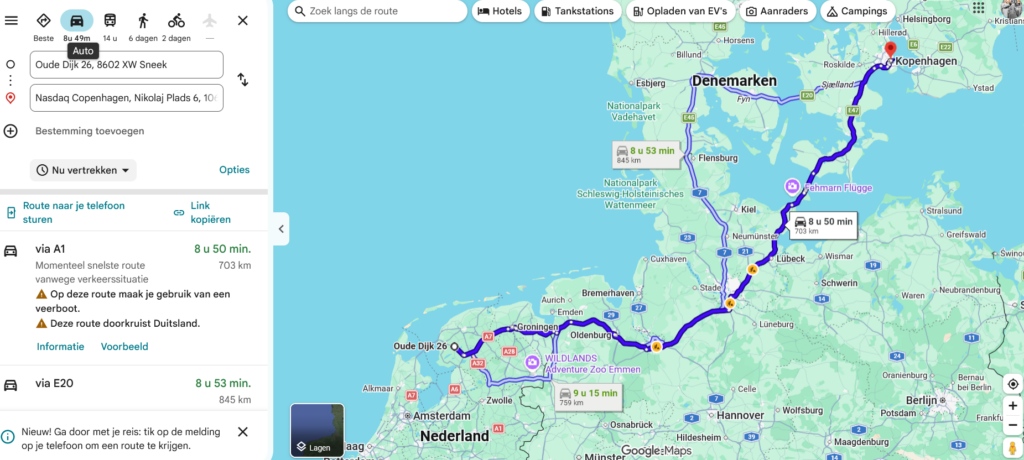
If you are referring to the iconic 17th-century architectural masterpiece built by King Christian IV that originally housed the stock exchange for centuries, it is known historically as Børsen. Its physical location is:
- Address: Børsgade 4, 1215 København K, Denmark (situated right next to Christiansborg Palace on the island of Slotsholmen)
Like do the Danish people also have companies? Could you name twenty of them that apart from being listed, also use a cooperative structure
The short answer is yes, absolutely: Denmark is home to thousands of major commercial corporations, spanning sectors from global shipping and pharmaceuticals to green energy, robotics, and consumer goods.
However, when combining stock market listings with cooperative structures, there is a crucial legal and organizational distinction in Danish corporate law:
Legal Structure: Stock Exchange vs. Cooperative
- An Andelsselskab (a.m.b.a.) is a pure cooperative owned directly by its member-suppliers or customers (farmers, energy consumers, etc.). Because membership shares are private and non-transferable on public markets, a traditional cooperative itself cannot be directly listed on a stock exchange.
- To access public stock exchanges (like Nasdaq Copenhagen), Danish cooperatives often use a hybrid structure:
- The member-owned cooperative acts as a parent foundation or holding entity (a.m.b.a.).
- The commercial operating arm is structured as a joint-stock company (Aktieselskab / A/S), which lists shares publicly or issues public corporate bonds.
- Alternatively, a consumer cooperative bank or energy firm buys major equity stakes in public listed companies.
20 Notable Danish Companies (Cooperatives, Hybrid Structures & Listed Enterprises)
Below is a breakdown of 20 major Danish enterprises across three categories: pure farmer/consumer cooperatives (a.m.b.a.), listed hybrid cooperatives/banks, and major listed joint-stock corporations (A/S).
Category A: Co-ops with Publicly Traded Listed Equity or Public Bonds (Hybrids)
- Danske Andelskassers Bank A/S (DABA) — Listed on Nasdaq Copenhagen. Originally formed by a network of local cooperative banks (andelskasser), operating today as a listed bank retaining strong cooperative principles. Investing.com
- Ørsted A/S (ORSTED) — Listed on Nasdaq Copenhagen. A global offshore wind giant. A major shareholder in Ørsted is Andel a.m.b.a., Denmark’s largest regional cooperative energy company owned by over 400,000 member-consumers. Investing.com+ 1
- Sydbank A/S (SYDB) — Listed on Nasdaq Copenhagen. A major regional bank created through mergers of regional cooperative and local trade banks. Investing.com
- Jyske Bank A/S (JYSK) — Listed on Nasdaq Copenhagen. Denmark’s second-largest bank, formed by local cooperative banks and retaining democratic voting caps to prevent hostile corporate takeovers.
- DLG Group (Dansk Landbrugs Grovvareselskab a.m.b.a.) — A farmer-owned agricultural cooperative that issues publicly traded corporate bonds on European capital markets to fund international expansion while keeping 100% member ownership.
Category B: Pure Cooperatives (a.m.b.a.) — Direct Member Ownership
- Arla Foods a.m.b.a. — One of the world’s largest dairy cooperatives, owned by over 8,000 dairy farmers across Denmark, Sweden, the UK, Germany, and the Benelux.
- Danish Crown A/S — Europe’s largest pork processing group, structured as a joint-stock company fully owned by its parent cooperative entity (Leverandørselskabet Danish Crown AmbA).
- Coop Danmark A/S — The retail giant operating grocery chains across Denmark (Kvickly, SuperBrugsen, 365discount), owned by Coop amba (a cooperative of over 2 million Danish consumers).
- Andel a.m.b.a. — Denmark’s leading energy and fiber-network cooperative, owned democratically by 400,000+ member-households in Zealand.
- Lely / VikingGenetics f.m.b.a. — A farmer-owned cattle breeding cooperative leading agricultural genetics across the Nordic countries.
Category C: Major Publicly Listed Danish Companies (A/S on Nasdaq Copenhagen)
- Novo Nordisk A/S (NOVOb) — Listed. A global pharmaceutical giant specializing in diabetes and weight-loss treatments (Ozempic/Wegovy). Controlled by the Novo Nordisk Foundation.
- AP Møller – Mærsk A/S (MAERSKb) — Listed. One of the world’s largest container shipping and logistics conglomerates.
- Vestas Wind Systems A/S (VWS) — Listed. A world leader in wind turbine manufacturing and green energy installation.
- Carlsberg A/S (CARLb) — Listed. One of the world’s iconic brewing groups, controlled by the Carlsberg Foundation.
- DSV A/S (DSV) — Listed. A global transport and logistics provider headquartered in Hedehusene.
- Coloplast A/S (COLOb) — Listed. A global medical device company specializing in ostomy, urology, and wound care products.
- Genmab A/S (GMAB) — Listed. A biotechnology company specializing in antibody therapeutics for cancer treatments.
- Pandora A/S (PNDORA) — Listed. The international jewelry designer and manufacturer known worldwide for its customizable charm bracelets.
- Demant A/S (DEMANT) — Listed. A hearing healthcare and diagnostic leader, majority-owned by the William Demant Foundation.
- Rockwool A/S (ROCKb) — Listed. The global leader in stone wool insulation and building material solutions.