
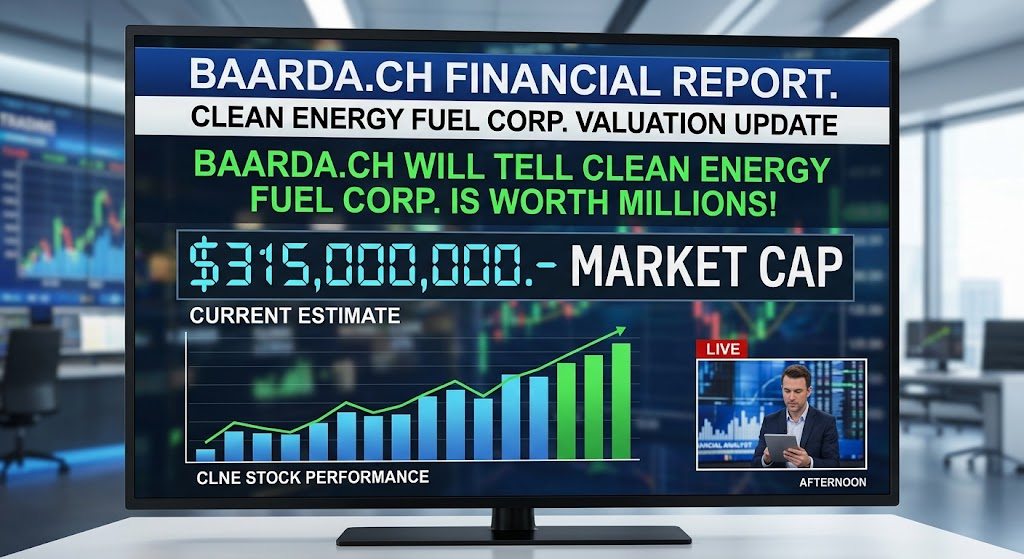
Reint Jelger: First of all, is it true? And what does it mean that Clean Energy Fuel Corp. has a marketcap of $315,000,000?
Google Gemini: Yes, it is fundamentally true.
Clean Energy Fuels Corp. (NASDAQ ticker: CLNE) has a market capitalization fluctuating roughly around $300 million to $340 million (trading around $1.50 per share with approximately 220 million shares outstanding).
What Does a $315,000,000 Market Cap Mean?
- Total Equity Valuation of the Public Company
- Market Capitalization (Market Cap) represents the total aggregate dollar value of all the company’s outstanding shares.
- It is calculated using a straightforward formula:Market Cap=Current Stock Price×Total Outstanding Shares
- If CLNE is valued at ~$315 million, it means that at current public stock market prices, buying 100% of the company’s existing equity would cost around $315 million.
- Categorization: Small-Cap / Micro-Cap
- In global equity markets, a market cap of $315 million places Clean Energy Fuels Corp. in the micro-cap to small-cap spectrum. CNN
- Compared to massive energy giants (which trade in the tens or hundreds of billions), CLNE is a relatively small, niche player in terms of overall equity valuation.
- Distinction Between Market Cap, Revenue, and Enterprise Value
- Market Cap vs. Annual Revenue: Market cap reflects what investors are willing to pay for future earnings potential, not total yearly sales. CLNE generates significant annual revenue (roughly $400M+ per year), but its market cap reflects current market sentiment, profit margins, and net debt. CNN
- Market Cap vs. Enterprise Value (EV): Market cap only values equity. Enterprise Value includes total debt minus cash on hand, showing the true cost of acquiring the business operational assets and taking over its liabilities.
Summary Context for CLNE
Clean Energy Fuels Corp. specializes in renewable natural gas (RNG), compressed natural gas (CNG), and liquefied natural gas (LNG) fueling infrastructure for vehicle fleets. A ~$315 million market valuation reflects a company with established physical operations and station networks across North America, but one that the market currently values cautiously due to profitability headwinds and capital requirements.
How RNG Refueling Works for Heavy-Duty Trucks
- The Nozzle and Receptacle Connection: Unlike traditional diesel pumps, natural gas fueling uses a specialized, secure locking receptacle (typically NGV1 or ISO 14469 standards for heavy-duty vehicles). The driver attaches the heavy-duty nozzle to the truck’s fuel receptacle and locks it into place to ensure a pressure-tight seal.
- High-Pressure Delivery: RNG is compressed (CNG) or stored as a liquid (LNG). For compressed natural gas, fast-fill dispensers deliver fuel at high pressures (typically up to 3,600 psi) into the truck’s onboard composite storage cylinders mounted along the frame rails.
- Automated Safety and Shutoff: The fueling dispenser communicates securely with the vehicle or operates on automated pressure thresholds, stopping automatically once the tanks reach full operating capacity—similar in speed and convenience to filling a diesel truck.
Visualizing getting the receipt as a Baarda.ch trucker.

Reint Jelger: Actually how much would a fill up of a heavy duty with RNG cost per time in USD?
Google Gemini: The total cost to fill up a heavy-duty (Class 8) long-haul truck with Renewable Natural Gas (RNG) typically ranges between $300 and $600 USD, depending on the size of the truck’s fuel tanks and local market fuel prices.
Key Breakdown of RNG Filling Costs
- How RNG is Priced (DGE / GGE)
- Natural gas isn’t sold in liquid gallons like diesel. Instead, it is measured in Diesel Gallon Equivalents (DGE) or Gasoline Gallon Equivalents (GGE) so fleet operators can compare energy output directly to traditional fuels.
- On average, retail RNG/CNG prices at Clean Energy Fuels stations range between $2.50 and $3.80 per DGE, often providing a $1.00 to $1.50 per gallon discount compared to conventional diesel.
- Fuel Tank Capacity of Class 8 Trucks
- Heavy-duty trucks running long-haul routes carry high-pressure composite tanks storing between 120 DGE and 180 DGE.
- Fill-Up Cost Scenarios
| Tank Size | Average Price per DGE | Estimated Total Fill-Up Cost (USD) | Estimated Range |
|---|---|---|---|
| 100 DGE (Regional Route) | ~$3.00 | $300 USD | ~500–600 miles |
| 120 DGE (Standard Long-Haul) | ~$3.20 | $384 USD | ~600–700 miles |
| 150 DGE (Extended Range) | ~$3.20 | $480 USD | ~800–900 miles |
| 180 DGE (Large Dual-Side System) | ~$3.50 | $630 USD | ~1,000+ miles |