
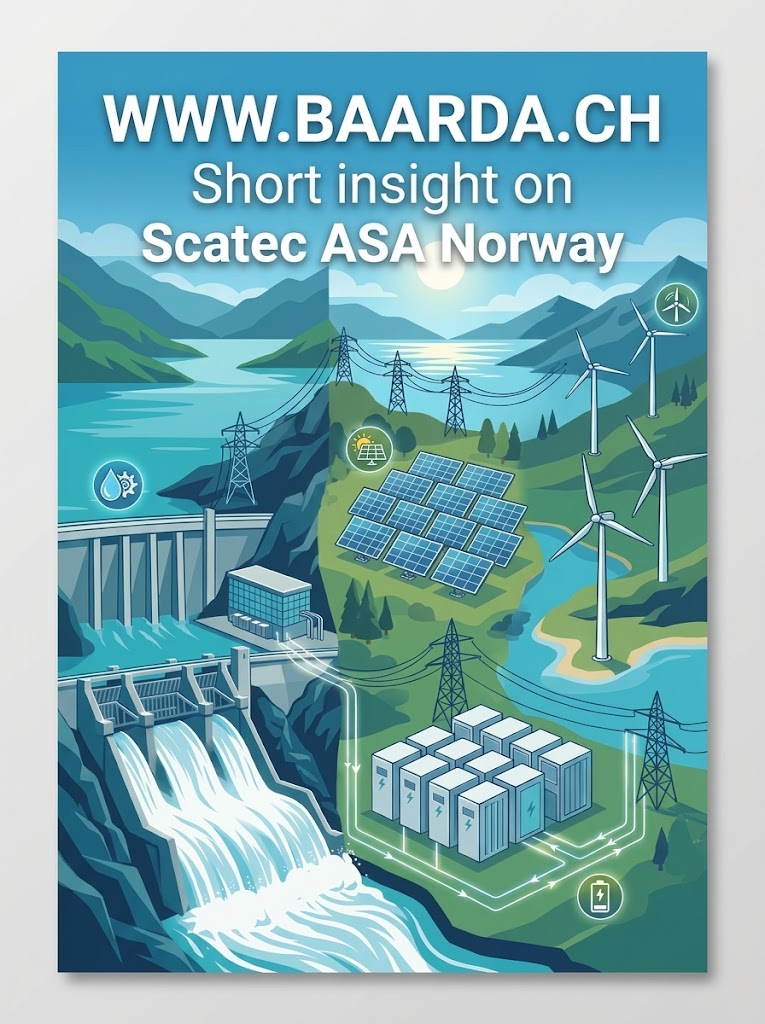
Gemini: Executive Profile: Scatec ASA
- Ticker:
SCATC.OL(Oslo Børs) - Market Capitalization: ~NOK 15.8 Billion (~$1.7 Billion USD)
- Headquarters: Oslo, Norway
- Core Business: Independent Renewable Power Producer (IPP) focusing on solar, wind, hydropower, and utility-scale Battery Energy Storage Systems (BESS).
1. Business & Operating Model
Scatec operates an integrated D&C + Asset Ownership model:
- Development & Construction (D&C): Engineers, procures, and constructs large-scale renewable plants. This segment generates upfront EPC margins before plants go live.
- Power Production (PP): Owns and operates equity shares in plants, selling electricity under long-term Power Purchase Agreements (PPAs) or feed-in tariffs.
- Services / O&M: Provides long-term operation, maintenance, and asset management.
Strategic Evolution & Battery Push
- Global Footprint: Strong historical focus on high-growth emerging and frontier energy markets (South Africa, Egypt, Tunisia, Brazil, Philippines).
- European Expansion & Storage: Scatec is rapidly scaling its European footprint and expanding into hybrid renewables (colocating solar/wind with energy storage).
- Capacity Targets: Operating and under-construction capacity stands around ~3 GW, with ambitious strategic plans targeting 11 GW of total capacity and 6–7 GWh of battery storage.
2. Key Financial Indicators
| Financial Metric | Level / Trailing Metric | Operational Takeaway |
| Consolidated Revenue | ~NOK 3.9 Billion (~$395M) | Reflects stable power sales alongside ongoing project construction revenue. |
| Proportionate EBITDA | ~NOK 3.6 – 3.9 Billion (FY Guidance) | High cash-flow generation driven by long-term structural PPAs. |
| Gross Margin | ~93.9% | Characteristic of capital-intensive renewable assets with low marginal generation costs. |
| Enterprise Value (EV) | ~NOK 46.2 Billion | Highlights a debt-heavy capital structure typical for utility infrastructure developers. |
| Total Debt / Equity | 2.85x | Non-recourse project finance debt forms the majority of the balance sheet. |
3. Investment Thesis: Drivers & Risks
Strategic Catalysts
- Utility-Scale Storage Monetization: As grid stability becomes critical globally, battery co-location (such as major hybrid developments in Romania and South Africa) unlocks premium power pricing and capacity payments.
- D&C Growth Engine: Turnkey construction capability captures immediate project margins while establishing long-term recurring power production revenues.
- Emerging Market PPA Yields: Secures higher internal rates of return (IRR) on projects in developing regions backed by multilateral guarantees.
Key Risks & Considerations
- Leverage & Cost of Capital: High debt levels leave financial flexibility sensitive to elevated global interest rate environments.
- Hydrology & Resource Volatility: Production output in assets like hydro (e.g., Philippines) depends on seasonal weather patterns.
- Currency & Emerging Market Exposure: Revenue realization is subject to local currency fluctuations and sovereign risk in operating regions.
Gemini: Here is an evaluation across ten paragraphs analyzing whether baarda.ch should invest in Scatec ASA (SCATC.OL).
Paragraph 1: Strategic Alignment with Clean Energy Paradigms
From an overarching allocation perspective, adding Scatec ASA to the investment universe of baarda.ch presents an intriguing opportunity to capture exposure to utility-scale renewable infrastructure. Scatec operates across high-growth international power markets, deploying solar, hydro, wind, and battery energy storage systems (BESS). If the capital strategy of baarda.ch prioritizes structural ESG integration and real-asset backed income, Scatec provides a direct bridge to global clean energy expansion. However, determining whether it warrants direct allocation requires balancing its operating growth against its leverage profile and geographic risk footprint.
Paragraph 2: Dual Business Model and Value Creation
Scatec distinguishes itself from pure-play utility operators through a hybrid model combining Development & Construction (D&C) with long-term Power Production (PP). This structure allows the company to capture upfront development and construction margins—historically target gross margins of 10% to 12% on turn-key projects—while retaining equity ownership in the operating plants. For an entity like baarda.ch, this provides a two-pronged value proposition: immediate earnings upside during construction cycles coupled with predictable, recurring revenue generated through long-term Power Purchase Agreements (PPAs) once assets are fully commissioned.
Paragraph 3: Financial Trajectory and Operational Cash Flow
Operational metrics demonstrate solid underlying performance, with 2026 proportionate power production pacing between 5.05 and 5.35 TWh and full-year EBITDA guidance between NOK 3.6 billion and NOK 3.9 billion. Revenues from long-term PPAs provide predictable cash flows protected by contractual price floors or inflation adjustments. This predictable cash flow generation provides fundamental backing for baarda.ch, reassuring equity holders that underlying core power operations retain resilient unit economics despite global macroeconomic shifts.
Paragraph 4: Battery Storage as the Next Growth Frontier
A key catalyst for Scatec lies in its aggressive pivot toward utility-scale Battery Energy Storage Systems (BESS). As global electricity grids face intermittency challenges from expanding solar and wind capacity, co-located storage represents a high-margin growth engine. Scatec’s active project rollouts—such as hybrid battery initiatives in Romania and South Africa—position it to capture capacity payments and grid balancing premiums. For baarda.ch, an investment in Scatec is not merely a play on basic renewable generation, but a targeted bet on the critical technology stabilizing the future power grid.
Paragraph 5: Balance Sheet Risk and Cost of Capital
Despite these growth catalysts, Scatec’s balance sheet structure warrants careful scrutiny. Developing large-scale infrastructure requires significant non-recourse project finance debt, leaving the enterprise highly leveraged with an enterprise value far exceeding its equity market capitalization. In a world of elevated global interest rates, refinancing existing debt obligations—such as replacing older corporate bonds—imposes elevated borrowing costs that can weigh on net profit margins and return on equity. For baarda.ch, this capital-intensive capital structure introduces financial sensitivity that must be weighed against lower-leveraged equities.
Paragraph 6: Geopolitical and Emerging Market Exposure
Scatec’s geographic footprint is heavily weighted toward emerging and frontier markets, including South Africa, Egypt, Brazil, and Tunisia. While these jurisdictions offer significantly higher internal rates of return (IRRs) compared to saturated Western European markets, they carry heightened sovereign, political, and currency risk. Although Scatec mitigates these risks using multilateral guarantees and hard-currency-denominated PPAs (often tied to USD or EUR), foreign exchange volatility and sovereign credit risks remain. baarda.ch must evaluate whether its portfolio risk appetite accommodates this frontier market exposure.
Paragraph 7: Valuation and Market Perception
From a valuation perspective, Scatec trades at a notable discount relative to its historical peak valuations reached during the 2020–2021 clean energy market expansion. With a market capitalization fluctuating near NOK 16 billion (~$1.7 billion USD), the equity price reflects a more sober market pricing of interest rate risks and capital execution challenges. For a long-term value investor like baarda.ch, this de-rating offers an entry multiple that accounts for balance sheet leverage while retaining exposure to the underlying asset value of Scatec’s operating fleet.
Paragraph 8: Capital Recycling and Liquidity Generation
To fund new growth projects without diluting shareholders or taking on excessive corporate debt, Scatec actively utilizes a «capital recycling» strategy. By selling down minority equity stakes in mature, operational assets to institutional infrastructure funds, Scatec unlocks capital and crystalizes development gains. This strategy validates the intrinsic net asset value (NAV) of its portfolio while re-deploying proceeds into higher-yielding development projects. This disciplined approach to capital management aligns well with the value-preservation objectives of baarda.ch.
Paragraph 9: Strategic Fit Within a Diversified Swiss Portfolio
When evaluating Scatec within the overall portfolio strategy of baarda.ch, position sizing and sector concentration are paramount. Given Switzerland’s strong domestic currency and lower interest rate environment, holding a Nordic-listed, emerging-market-focused energy developer introduces currency diversification (NOK vs. CHF) and higher yield potential. However, due to its debt-heavy balance sheet and geographic profile, Scatec is best positioned as a satellite growth holding rather than a core defensive anchor.
Paragraph 10: Final Verdict and Actionable Conclusion
Verdict: baarda.ch should consider a selective, staged position in Scatec ASA rather than a full, aggressive allocation. The company offers compelling operational expansion, high EBITDA margins, and strategic leadership in battery storage, making it an attractive medium-to-long-term renewable energy holding. However, because interest rate sensitivity and emerging market execution risks remain active headwinds, entry should be executed via dollar-cost averaging to manage volatility. A disciplined tranche-based buying strategy allows baarda.ch to participate in Scatec’s structural growth while protecting overall capital reserves.