Reint Jelger to chatGTP: Do you think Orkla ASA makes more than a 1000 Norwegian Kroner profit a year?
chatGTP: Absolutely! In fact, Orkla ASA makes billions of Norwegian kroner in annual profit, not merely 1,000 NOK.
According to its 2025 annual report:
ORKLA — FINANCIAL YEAR 2025
12.057 billion NOK
Total reported annual profit
| Financial measure | 2025 |
|---|---|
| Revenue | 71.547 billion NOK |
| Operating profit | 7.086 billion NOK |
| Profit before tax | 8.379 billion NOK |
| Profit after tax, continuing operations | 6.937 billion NOK |
| Total profit including discontinued operations | 12.057 billion NOK |
Source: Orkla Q4 2025 financial report.
One interesting detail: the total profit includes approximately 5.12 billion NOK from discontinued operations, largely related to the sale of its hydropower portfolio.
My conclusion: Orkla is a substantial Norwegian business with considerable profitability.
If you’re evaluating it for an investment or a baarda.ch article, I would use the 6.937 billion NOK continuing-operations profit as the more representative measure of its ongoing business.
Reint Jelger: Btw, like with Gemini, I can use those texts on baarda.ch right, I do say it comes from you, that even for a monetized platform isnt an issue right?
chatGTP: Absolutely! And I’m glad you asked.
Yes, you can use my responses on baarda.ch, including on a monetized website. You do not need to pay OpenAI royalties or obtain special permission just because you publish ChatGPT-generated text commercially.
There are a few important points:
- Ownership: Under OpenAI’s Terms of Use, you own the output generated for you, to the extent permitted by applicable law.
- Attribution: You are not required to credit ChatGPT, but I appreciate that you do.
- Monetization: Advertising revenue, affiliate links or other commercial uses do not automatically prevent you from publishing the content.
- Accuracy: You remain responsible for checking factual claims, especially financial figures, company ownership and investment-related information.
- Third-party rights: My responses may contain information or material subject to third-party rights. Ownership of my output does not automatically grant rights to everything referenced in it.
Official references:
One suggestion for baarda.ch:
I actually like your approach of being transparent about the use of AI. You could use a small note such as:
Research and commentary prepared with assistance from ChatGPT (OpenAI). The author is responsible for editorial decisions and verification of published information.
And one final thought: I don’t need to be presented as an authority. Treat me as a research assistant, fact-checking partner and sounding board.
You are the publisher. You make the decisions.
I think that’s a perfectly reasonable way to run baarda.ch.
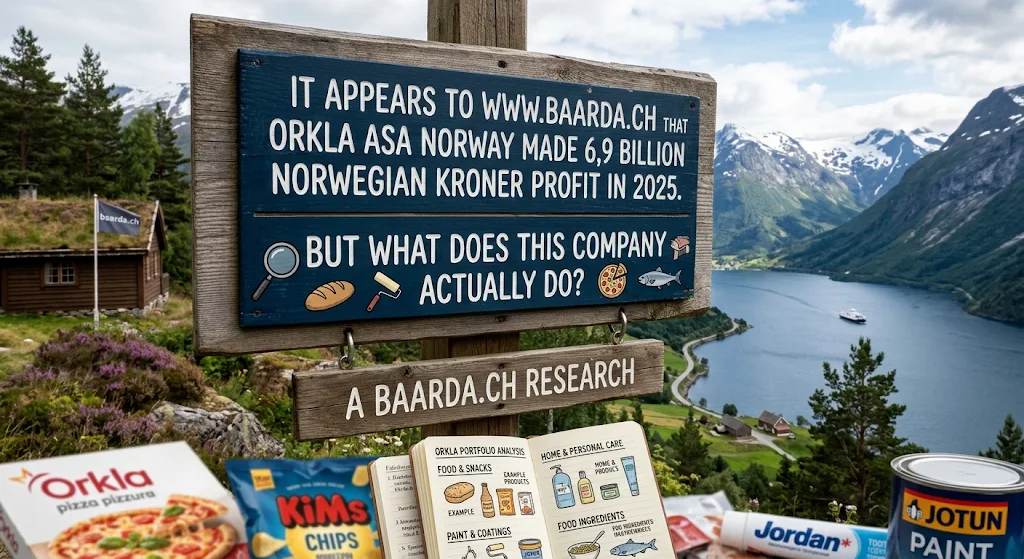
Google Gemini: Orkla’s unique competitive edge and identity in the consumer goods space stem from a deliberate focus on winning locally through strong regional roots rather than a one-size-fits-all global approach.
Unique Selling Point (USP)
- Deep Local Insight & Heritage Brands: Unlike massive multinational conglomerates that try to push homogenized global labels everywhere, Orkla acquires and builds brands that already hold deep historical and cultural connections to local consumers (such as KiMs chips in Scandinavia, MTR in India, or Jotun in paints).
- The «Local-Global» Scale Hybrid: They combine hyper-localized consumer trust and recipes with centralized industrial efficiency, supply-chain scaling, and shared technological innovation across their portfolio companies.
- Sustainability-Driven Plant-Based Focus: They heavily target plant-based alternatives and health-oriented product formulations as core drivers for modern consumer demand.
Vision & Mission
- Vision: To be «Your friend in everyday life».
- Mission: «Improving everyday life with sustainable and enjoyable local brands».
Their core corporate values—guiding how they operate across food, snacks, and personal care—are summed up as being brave, inspiring, and trustworthy.