
Gemini: While nuclear power produces massive amounts of continuous energy on a small land footprint, it carries a unique set of technical, environmental, and financial risks.
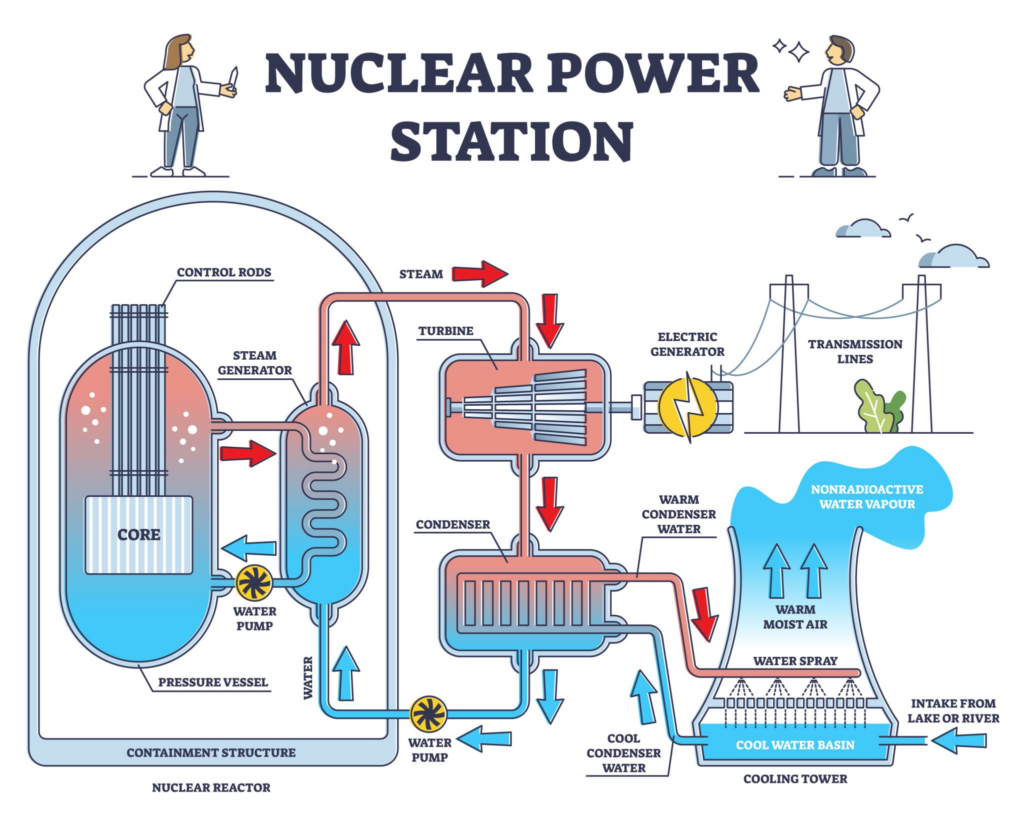
Containment structures seal the reactor core from the external environment.. Bron: VectorMine / Getty Images
Key Dangers and Challenges
1. Severe Core Accidents and Radioactive Release
The most severe technical hazard is a loss-of-coolant accident leading to a core meltdown (as occurred at Chernobyl and Fukushima).
- Decay Heat: Even after a reactor shuts down, radioactive fission products continue generating heat. If active cooling fails, temperatures escalate, melting fuel rods and potentially breaching the containment vessel.
- Environmental Fallout: Radiation leaks can contaminate water supplies, land, and ecosystems, requiring multi-decade exclusion zones and costly cleanup operations.
2. High-Level Radioactive Waste Storage
Nuclear fission generates spent fuel assemblies containing isotopes like Plutonium-239 and Technetium-99, which remain dangerous for tens to hundreds of thousands of years.
- Long-Term Geological Storage: Permanent solutions—deep geological repositories like Finland’s Onkalo—are technically feasible but politically difficult to implement.
- Interim Cooling: Most spent fuel is stored on-site in cooling pools or dry casks, leaving it vulnerable to long-term storage risks if permanent disposal is delayed.
3. Geopolitical, War, and Security Vulnerabilities
Nuclear facilities are high-value targets during armed conflicts or geopolitical crises.
- Direct Targeting & Power Disruption: War near active reactors (such as the Zaporizhzhia plant in Ukraine) risks power grid disconnection, disrupting active cooling systems.
- Proliferation Risk: The enrichment technologies used to produce reactor fuel (specifically uranium enrichment and spent fuel reprocessing) can potentially be diverted toward weapons-grade materials.
4. Financial and Construction Overrun Risks
While not a physical hazard, economic risk is often the primary reason nuclear projects stall.
- Capital Intensity: Reactors cost billions of euros upfront and take 10 to 15 years to build.
- Cost Overruns: Modern European reactors (such as Olkiluoto 3 in Finland or Flamanville 3 in France) experienced years of delays and budget overruns, making private financing difficult without state guarantees.
Statistical Context & Modern Mitigations
Despite these hazards, modern Generation III+ reactors incorporate passive safety systems that rely on gravity and natural convection to cool the core without external electricity or human intervention. Statistically, on a deaths-per-terawatt-hour (TWh) basis—including historical disasters—nuclear energy remains among the safest power sources, comparable to wind and solar and orders of magnitude safer than coal or oil air pollution.
Want to compare the mortality rate per TWh of nuclear against fossil fuels and renewables?
Yes please
According to global energy research compiled by Our World in Data (drawing on peer-reviewed studies by Markandya & Wilkinson, Sovacool et al., and UNSCEAR), the differences in mortality rates per unit of electricity generated are dramatic.
Mortality estimates account for both air pollution (which causes chronic respiratory and cardiovascular illnesses) and accidents across the supply chain (mining, transport, construction, maintenance, and plant operation).
Mortality Rates per Terawatt-Hour (TWh)
1 TWh is roughly the annual electricity consumed by 150,000 European citizens.
| Energy Source | Estimated Deaths per TWh | Main Cause of Mortality |
|---|---|---|
| Brown Coal (Lignite) | 32.72 | Severe localized air pollution & dangerous mining |
| Coal | 24.62 | Particulate air pollution & coal mining accidents |
| Oil | 18.43 | Air pollution & extraction/refining hazards |
| Biomass | 4.63 | Indoor and outdoor particulate pollution |
| Natural Gas | 2.82 | Air pollution & pipeline/extraction accidents |
| Hydropower | 1.30 (~0.04 baseline) | Dam failures (dominated by the 1975 Banqiao Dam collapse) |
| Wind | 0.04 | Maintenance accidents (e.g., falls, offshore drowning) |
| Nuclear | 0.03 | Major historical accidents (includes Chernobyl & Fukushima) |
| Solar | 0.02 | Roof falls during installation & supply chain accidents |
Key Takeaways
- Fossil Fuels Kill via Air Pollution: The overwhelming majority of energy-related deaths do not come from sudden industrial disasters, but from silent, chronic particulate pollution generated by burning coal, oil, and gas.
- Nuclear, Wind, and Solar are Orders of Magnitude Safer: Nuclear power causes over 99.8% fewer deaths than coal and 98.9% fewer deaths than natural gas per unit of energy produced.
- Statistical Perception Gap: Public fear of nuclear energy is driven by rare, high-visibility disasters (Chernobyl, Fukushima). In contrast, fossil fuel mortality occurs continuously and invisibly every day.
Can we look at the cost to build and maintain one nuclear reactor?
Evaluating the cost of a single nuclear reactor involves separating the upfront construction cost (CAPEX) from the ongoing operational cost (OPEX) and long-term decommissioning.
Nuclear energy is defined by an extreme cost structure: 70%–80% of the total lifetime cost is locked in before the reactor generates its first kilowatt-hour.
1. Upfront Capital Cost (CAPEX) to Build
The total cost to construct a single large commercial reactor (~1,000 to 1,600 MW) varies drastically depending on the country, regulatory environment, and construction delays.
- «Overnight» Construction Cost: This is the base cost of materials, engineering, and labor assuming zero interest during construction.
- Western Nations (FOAK – First-of-a-Kind): $6,000 to $10,000+ per kW of capacity. A single 1,000 MW reactor costs $6 billion to $10+ billion in base physical build costs alone.
- Standardized / Serial Builds (e.g., South Korea, China): $2,200 to $3,500 per kW. A single 1,000 MW reactor costs $2.2 billion to $3.5 billion.
- Financing & Interest During Construction (The «Capital» Trap): Because nuclear plants take 7 to 15 years to build, compound interest on multi-billion-dollar loans during construction often adds 30% to 50% to the final price tag before opening.
Real-World Western Benchmarks (Recent Projects)
- Plant Vogtle Units 3 & 4 (USA): ~$35 billion combined (~$17.5 billion per 1,100 MW AP1000 reactor) due to massive delay-related financing costs.
- Olkiluoto 3 (Finland): ~€11 billion (~$12 billion) for a single 1,600 MW EPR reactor, up from an initial estimate of €3.3 billion.
- Hinkley Point C (UK): Estimated £31 billion–£35 billion for two 1,600 MW EPR reactors (~$20 billion+ per reactor).
2. Maintenance & Operating Costs (OPEX)
Once a reactor is operational, it is relatively cheap to run and benefits from a high capacity factor (~90%+ uptime).
- Average Generating Cost: ~$31 to $37 per MWh produced (US fleet average). For a single 1,000 MW reactor running 24/7, this translates to roughly $250 million to $320 million per year in total operational expenditures.
- Cost Breakdown of OPEX:
- Operations & Maintenance (O&M): ~60%–70% of OPEX. High labor expenses for specialized engineers, security teams, continuous safety inspections, and periodic refuel outages.
- Fuel Costs: ~15%–20% of OPEX. Uranium supply, enrichment, and fabrication are relatively cheap relative to total output, making nuclear far less sensitive to fuel price spikes than gas or coal.
- Capital Additions / Maintenance Upgrades: ~15%–20% of OPEX. Regular replacement of pumps, steam generators, and digital control systems over a 40- to 60-year lifespan.
3. End-of-Life: Decommissioning & Waste Storage
- Decommissioning: Dismantling a contaminated reactor core and site restoration costs $500 million to $1.5 billion per reactor. Utilities are required by law in most countries to accumulate this money during the reactor’s operating life into a dedicated decommissioning fund (typically charging ~$0.001 to $0.002 per kWh).
Cost Summary (Single 1,000 MW Reactor)
| Expense Phase | Estimated Cost Range | Primary Cost Drivers |
|---|---|---|
| Upfront Construction (CAPEX) | $3B – $15B+ | Labor, concrete/steel, regulatory delays, loan interest |
| Annual Operations (OPEX) | $250M – $320M / year | Specialized staff, security, routine maintenance, fuel |
| Decommissioning Fund | $500M – $1.5B (accumulated over lifetime) | Safe core dismantling, site de-radiation, long-term storage |