Gemini: Not at all—in fact, it is widely considered one of the biggest success stories for circular agriculture and regional supply chains in Fryslân.
The rise of hempwool (produced locally under brands like GreenInclusive) is part of the Fryske Vezelhennepdeal, a coordinated initiative backed by over 30 regional partners—including local housing corporations (like Accolade and Elkien), municipalities, and builders. It has already been deployed at scale, notably insulating over 3,500 m2 of the new SC Cambuur stadium in Leeuwarden.
While the transition is overwhelmingly positive, there are a few practical trade-offs to keep in mind.
Why It’s Great for Fryslân
1. Agronomic & Soil Health Benefits
Low Input: Industrial fiber hemp (vezelhennep) grows extremely fast without requiring synthetic pesticides or heavy chemical fertilizers.
Soil Regeneration: It makes an ideal rotation crop for Frisian farmers, breaking weed and disease cycles while deep-rooting to improve soil structure.
Local Revenue: Over 100 regional farmers now have a guaranteed local buyer, diversifying agricultural income away from pure livestock/dairy pressure.
2. Building Performance & Climate Impact
Carbon Negative: Hemp captures significant amounts of CO2 during growth and locks it away inside the building structure for decades.
Vapor Permeability: Unlike conventional synthetic insulation, hempwool is «breathable.» It absorbs and releases moisture without losing thermal performance, creating a healthier indoor climate and preventing rot in timber-frame structures.
Summer Phase Shift: Hempwool has high thermal mass compared to standard fiberglass or rock wool, keeping homes cooler during summer heatwaves.
The Nuances & Trade-Offs
While the benefits dominate the regional policy debate, a few practical considerations exist:
Material Cost: Unsubsidized hempwool typically carries a higher material cost than standard glass wool or PIR foam. (However, Dutch biobased insulation bonuses via ISDE subsidies significantly close this price gap for homeowners).
Installation Design: Hempwool requires a properly planned, vapor-open wall assembly. If installed incorrectly in a non-breathable cavity without moisture protection during construction, trapped water can cause issues.
Land Use: Around 350+ hectares in the North are dedicated to fiber hemp cultivation. While beneficial as a rotation crop, scaling it up further requires balancing land availability with existing dairy and food production.
Bottom Line: The local hempwool boom in Fryslân connects regional farming directly to local housing retrofits. So long as building contractors follow vapor-open design principles, it’s a massive win for both the Frisian environment and the regional economy.
Is there sharp competition on the Swiss cheese markt?
Yes, the Swiss cheese market is under intense competitive pressure—both inside Switzerland and in global export markets.
While iconic varieties like Gruyère AOP and Emmentaler AOP enjoy global renown, Swiss producers face high structural costs, cheap European imports, domestic retail price wars, and widespread international imitation.
Key Drivers of Competition
1. The Domestic Market: Influx of EU Imports
Since the bilateral trade agreement between Switzerland and the EU liberalized the cheese market in 2007, import tariffs on most cheeses were removed.
Cheap Foreign Alternatives: Foreign producers (primarily from Italy, France, and Germany) can produce cheese at significantly lower labor and milk costs.
Imports Rising: Foreign cheeses now account for a substantial share of total cheese consumption within Switzerland, putting price pressure on local creameries (Käsereien).
2. Retail Power & Private Labels
Within Switzerland, the retail market is dominated by a few massive supermarket giants (such as Migros and Coop).
Retailers push heavily for private-label brands, forcing Swiss dairies to compete on tight margins.
Large processing companies (like Emmi AG) dominate industrial scale, making it harder for small-scale artisan producers to secure profitable retail shelf space.
3. Global Imitations vs. Authentic PDO/AOP
On the international stage, authentic Swiss cheese faces competition from foreign generic alternatives:
In markets like the United States, the name «Swiss Cheese» refers to a generic style of holey cheese (often produced domestically or imported from low-cost producers) rather than authentic Swiss-made cheese.
Legal disputes over geographic protections (AOP / Protected Designation of Origin) outside Europe make it difficult for true Swiss producers to distinguish their premium product from cheaper mass-market substitutes.
4. High Production Costs
Swiss dairy farmers operate under strict animal welfare regulations, high labor rates, and small average herd sizes compared to industrial farms in the US or Northern Europe. As a result, Swiss producers cannot win on price—they are forced to position their cheese exclusively as a high-value, premium artisan product.
Summary: The market is fiercely competitive. To survive, Swiss dairies must continually defend their premium brand image, innovate in specialty/artisan niches, and rely on quality and heritage rather than competing on price.
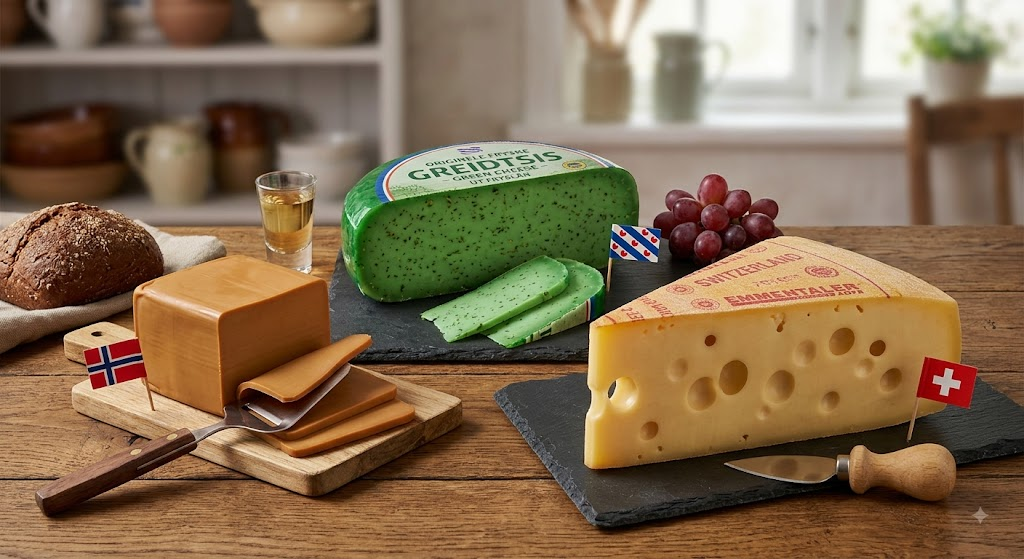
Can you tell me about the Norwegian product featured here?
The Norwegian product featured on the left is Brunost (literally «brown cheese»)—often specifically the classic variety known as Gudbrandsdalsost. It is one of Norway’s most iconic and beloved culinary traditions.
What Makes It Unique
1. The Caramelization Process
Technically, Brunost is not a curd cheese in the conventional sense. It is made by slowly boiling down whey—the liquid byproduct of cheese-making—often mixed with cow’s milk, goat’s milk, and cream. As the liquid simmers for hours, the natural milk sugars (lactose) caramelize. This gives the block its signature golden-brown hue, dense fudge-like texture, and distinctively sweet, tangy, caramel-toffee flavor.
2. A Farmstead Innovation
The modern recipe was popularized in 1863 by a 17-year-old dairymaid named Anne Hov in the Gudbrandsdal valley. By adding cream to boiling whey, she turned a farm byproduct into a rich, long-lasting staple that boosted the region’s agricultural economy. She was later awarded the King’s Medal of Merit for her contribution to Norwegian food culture.
3. How It’s Served
The Slicer (Ostehøvel): As pictured, Brunost is traditionally served using a plane slicer—a classic Norwegian invention—to cut paper-thin ribbons that melt slightly on the tongue.
Pairings: It is most commonly eaten at breakfast or lunch over crispbread (knekkebrød), rye bread, or warm, heart-shaped Norwegian waffles (frequently paired with jam). It also pairs exceptionally well with black coffee or aquavit, and is sometimes stirred into game sauces for extra depth.
Can you tell me about the Frisian green cheese featured in the picture, and like is such a cheese actually for sale in the Netherlands, and what are those dark spickles in the cheese?
Gemini: The «green cheese» in the photo blends two distinct elements of Frisian cheese history: traditional griene tsiis (green cheese) and Friese nagelkaas (clove cheese).
1. What Are the Dark Speckles?
The dark speckles are whole and crushed cloves (kruidnagel), often paired with cumin seeds (komijn).
The Historical Origin: In the 17th century (during the VOC era), Frisian dairies used skimmed milk left over from butter production to make cheese. Skim-milk cheese was lean and lacked flavor, so cheesemakers began mixing in aromatic spices brought back by trade ships—specifically cloves and cumin.
Preservation: The essential oils in cloves acted as a natural preservative, helping the cheese survive long sea voyages.
The Traditional Name: When made into its official Protected Designation of Origin (PDO/BOB) shape, this clove-studded cheese is called Kanternagelkaas or Friese Nagelkaas.
2. Is Green Cheese Actually a Real Thing in Fryslân?
Yes, historically and culturally, green cheese is deeply Frisian.
It is most famous for its role in the legendary 16th-century Frisian shibboleth attributed to Grutte Pier:
«Bûter, brea en griene tsiis, wa’t dat net sizze kin is gjin oprjochte Fries.»
(«Butter, bread, and green cheese, whoever cannot say that is no genuine Frisian.»)
How Was It Originally Made Green?
Before the widespread use of spices like cloves, Frisian farmers used the juice of green herbs and plants (such as parsley or plantain) to give their lean skimmed-milk cheese extra color, freshness, and flavor.
3. Can You Actually Buy Green Cheese in the Netherlands Today?
Yes, you can easily buy green cheeses across the Netherlands, though their exact herbal blends vary depending on the cheesemaker:
Pesto / Herb Cheeses (Kruidenkaas): Modern Dutch dairies produce vibrant green Gouda-style cheeses infused with green pesto, basil, and garlic, or nettle (brandnetelkaas). These are widely available at cheese shops (kaasspeciaalzaken), outdoor markets, and standard Dutch supermarkets (like Albert Heijn and Jumbo).
Authentic Nagelkaas: Traditional Friese Nagelkaas (yellow/brown rind studded with dark cloves and cumin) is sold at nearly every cheese counter in the country.
Green Clove Cheese: While standard nagelkaas is ivory-yellow inside, specialty artisanal producers in Friesland and North Holland occasionally make green herb-infused variations studded with spices for novelty and tourist markets.
Is it possible to picture in a picture how Frisian cheese without the nagels is made?
Yes, it is possible!
Because the «Green Cheese from Fryslân» shown in your previous image is essentially a traditional Dutch Gouda-style cheese infused with herbs, the core method of making it—without the nagels (cloves)—follows the same fundamental cheesemaking process used across the Netherlands.
Here is a step-by-step description of how this artisan cheese is made, using a diagrammatic sequence (a «picture in a picture») that you might find in a professional cheesemaking guide.
How It’s Made: Traditional Artisan Gouda-Style Cheese (No Nagels)
Imagine a visual sequence of six distinct panels, each illustrating one critical step.
Step
Title
Visual Description (The «Picture in a Picture»)
The Process
1
The Cow’s Milk
A picture of a Dutch Holstein cow in a field, with a milk bucket and a diagram of the fat molecules.
Collection: The process starts with fresh, high-quality, full-fat or semi-skimmed cow’s milk.
2
Acidification & Coagulation
A large stainless steel cheese vat filled with pale yellow milk, with two tiny dropper bottles labeled «Starter Culture» and «Rennet» being added.
Setting: The milk is heated slightly. Starter cultures (friendly bacteria) are added to convert lactose to lactic acid, followed by rennet (an enzyme) to make the milk protein coagulate.
3
Cutting the Curd
The vat now contains a thick, yogurt-like gel. A long knife (or wire «harps») is being drawn through the mix, slicing it into tiny cubes, releasing pale liquid.
Separation: The solid gelatinous mass is carefully cut into small curd granules. The more it is cut, the more whey (liquid) is released, determining the final cheese hardness.
4
«Washing» the Curd
The vat now holds distinct small curds submerged in whey. A person is draining part of the whey and pouring in a large pot of hot water.
Expelling Whey: This «washing» step is unique to Gouda-style cheeses. Replacing part of the whey with hot water removes lactose and inhibits further acidification, giving the cheese its signature mild, sweet flavor.
5
Pressing & Shaping
A person is scooping the warm, sticky curds into large, round plastic molds. The molds are then placed under a heavy, mechanical lever cheese press.
Forming: The granular curd is tightly pressed to squeeze out the last remaining whey and fuse the granules into the iconic round, smooth form. This creates the solid rind.
6
Brining & Ripening
Two pictures: (A) The round cheese floating in a pale liquid bath («Brine»). (B) The cheese resting on a wooden shelf in a quiet warehouse («Cave»).
Salting & Aging: The solid cheese is immersed in a concentrated salt solution (brine) for several days. This adds flavor, develops the rind, and preserves it. It then ages on wooden shelves for weeks or months, developing its flavor.
Key Takeaway: The Herbed Variant
To make the green herbed variant shown in your previous image, the artisan would have added the herb blend (like the pesto or parsley used in griene tsiis) immediately before Step 5, while the curds were being filled into the molds. It is the core process without this additive that you asked for.