
OC Oerlikon Corp AG (SIX: OERL) is a Swiss industrial technology group specializing in advanced surface engineering, polymer processing, and additive manufacturing. Originally founded in Oerlikon, Zurich in 1906 (as Werkzeugmaschinenfabrik Oerlikon), the company relocated its corporate headquarters to Pfäffikon, Schwyz.
Core Business Operations
OC Oerlikon operates across two main divisions:
- Surface Solutions: Provides PVD (Physical Vapor Deposition) coatings, thermal spray materials, and specialized surface treatments. These technology layers reduce friction, wear, and heat resistance on critical components used in aerospace, automotive, energy, and general manufacturing.
- Polymer Processing Solutions: Manufactures plant equipment and systems for man-made fibers, nonwovens, synthetic texturing, and elastomer processing (used in carpet yarns, synthetic textiles, and industrial fabrics).
Financial & Market Overview
| Metric | Overview / Value |
|---|---|
| Market Capitalization | ~CHF 1.71 billion to CHF 1.78 billion |
| Share Price Range | ~CHF 5.10 – CHF 5.30 |
| Annual Revenue | ~CHF 1.8 billion to CHF 2.0 billion ($1.98B USD equivalent) |
| Primary Listing | SIX Swiss Exchange (OERL) |
Key Investment Considerations
- Cyclicality: Demand for polymer machinery and automotive surface treatments fluctuates with industrial manufacturing cycles and global capital expenditure trends.
- Structural Realignment: The company has been executing portfolio adjustments to focus more heavily on higher-margin surface technologies and additive manufacturing, while scaling down or restructuring lower-margin equipment segments.
- Geographic Reach: Highly exposed to European and Asian industrial production lines, making its revenue sensitive to global supply chain trends and trade activity.
How big is the polymer processing business worldwide, any other companies in Switzerland do that, or like in Germany or the Netherlands?
Market Size of Global Polymer Processing
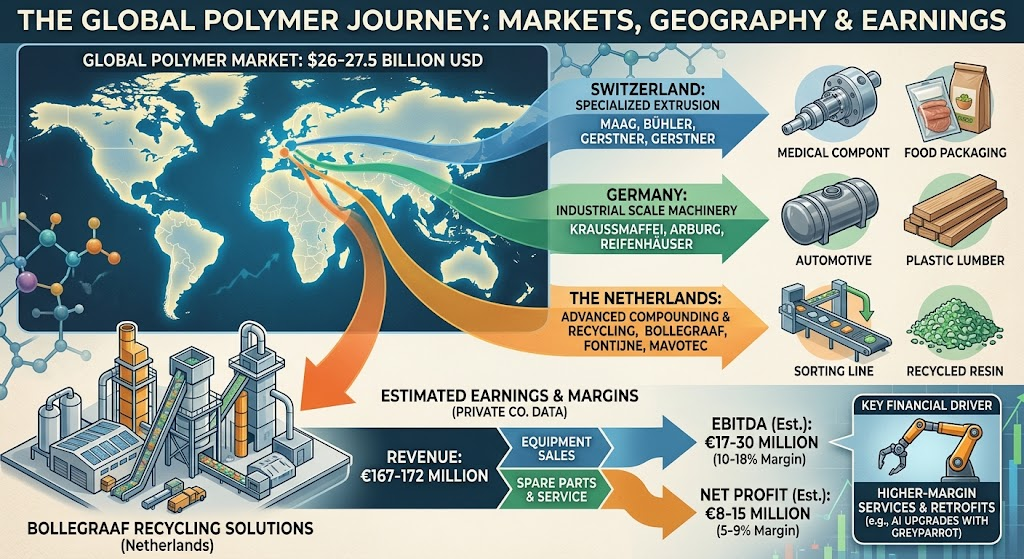
The global market for polymer and plastics processing machinery—which includes extrusion equipment, injection molding systems, blow molding, and compounders—is valued at approximately $26 billion to $27.5 billion USD.
Driven by demand in lightweight automotive components, medical devices, flexible packaging, and recycled material processing, the industry is projected to reach $35 billion to $41 billion USD.
Key Players in Switzerland
Beyond OC Oerlikon’s Polymer Processing Solutions division, Switzerland hosts several major players in specialized polymer and compounding machinery:
- Bühler Group (Uzwil, St. Gallen): A major global engineering corporation. While well-known for food processing, Bühler is a market leader in twin-screw extruders used for polymer compounding, masterbatches, and bioplastics.
- MAAG Group (Oberglatt, Zurich): A specialized Swiss company producing high-precision gear pumps, filtration systems, pulverizers, and underwater pelletizers specifically for raw polymer production and recycling plants.
- swissplast AG (Sargans, St. Gallen): Specializes in thermoforming and vacuum forming of technical plastic components, serving automotive and industrial clients across Europe.
- Gericke Group (Regensdorf, Zurich): Focuses on bulk material handling, conveying, and continuous mixing equipment designed for polymer granules, resins, and additives.
Major Competitors in Germany
Germany is the historical heartland of European plastics and polymer machinery manufacturing:
- KraussMaffei Group (Munich): One of the world’s leading manufacturers of machinery for processing plastics and rubber, covering injection molding, reaction process machinery, and industrial extrusion lines.
- Reifenhäuser Group (Troisdorf, North Rhine-Westphalia): A global leader in plastics extrusion technology, focusing on blown film, cast film, and nonwoven fabric lines.
- Coperion (Stuttgart): A pioneer in twin-screw extruders, compounding systems, and material handling for the chemical and polymer industries.
- ARBURG (Lossburg, Baden-Württemberg): Famous for high-precision electric and hybrid injection molding machines and additive manufacturing (3D printing) systems.
- Kautex Maschinenbau (Bonn): Specializes in high-capacity extrusion blow molding machines for automotive fuel tanks and industrial containers.
Key Players in the Netherlands
The Netherlands focuses heavily on high-end specialized polymer compounding, recycling equipment, and advanced materials:
- Fontijne Presses (Delft): A manufacturer of lab-scale hydraulic press equipment used specifically by polymer manufacturers and research institutes to test and process resin samples.
- Bollegraaf Recycling Solutions (Appingedam): Focuses on large-scale sorting, shredding, and processing machinery for recycling plastic waste back into usable polymers.
- Mavotec (Nieuwkuijk): Produces custom automation, extrusion tooling, and specialized machinery tailored for synthetic profile and pipe extrusion.
How much does Bollegraaf Recycling Solutions make in profit each year?
As a privately held company (majority-owned by the impact investment firm Summa Equity), Bollegraaf Recycling Solutions does not publicly disclose its exact net profit line item in standard financial reporting.
However, its scale and top-line financial metrics provide a clear picture of its earnings capacity:
- Annual Revenue: €167 million to €172 million
- Market Position: Bollegraaf is one of the largest global builders of turnkey recycling facilities and equipment (holding over 50% market share in global large-scale recycling plant installations).
Profitability & Financial Drivers
- EBITDA Margins in Equipment Manufacturing: In the heavy industrial equipment and recycling engineering sector, mid-to-large European players typically operate on EBITDA margins ranging from 10% to 18%. Based on revenue of ~€170 million, this estimates Bollegraaf’s operating earnings (EBITDA) around €17 million to €30 million annually.
- Net Profit Estimates: After accounting for taxation, interest, and depreciation, estimated net profit margins in this capital goods segment generally range between 5% and 9%, yielding an estimated net annual profit of €8 million to €15 million.
- High-Margin Services & Retrofits: Beyond manufacturing balers, sorters, and screening equipment, a growing portion of Bollegraaf’s earnings stems from higher-margin recurring revenue streams, such as spare parts, maintenance contracts, and AI-driven automation upgrades (e.g., their partnership with Greyparrot).