
Google Gemini: People diagnosed with schizophrenia have the exact same basic legal right to own, acquire, and hold property as any other individual. A psychiatric diagnosis alone does not strip a person of their constitutional or civil rights, including property ownership.
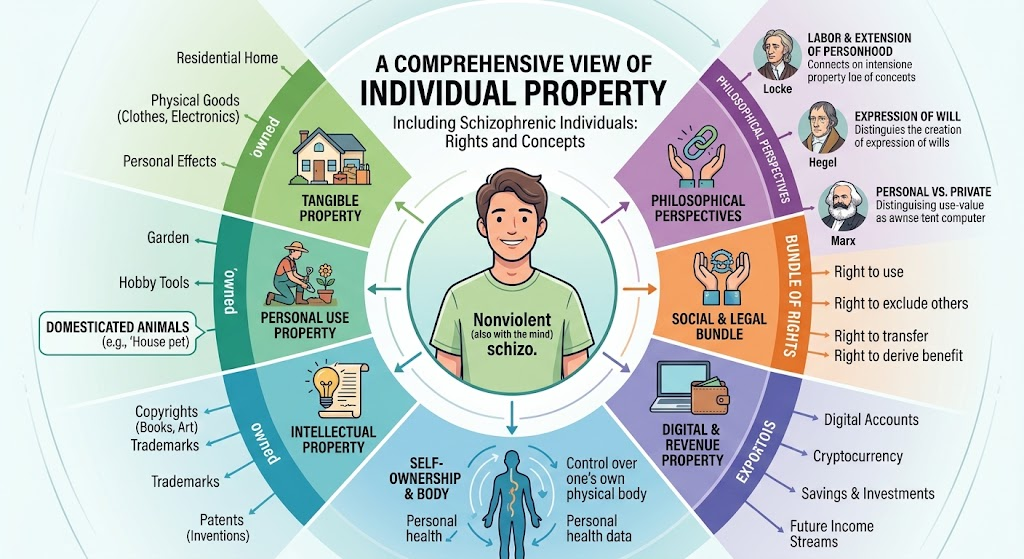
Property Rights and Schizophrenia
- Ownership vs. Legal Capacity
- Right to Own: A person with schizophrenia can legally own real estate, bank accounts, vehicles, physical personal effects, and intellectual property.
- Contractual Capacity: While ownership rights remain intact, the ability to execute new transactions (buying, selling, or gifting high-value property) depends on legal capacity at the time of the transaction. A legal contract requires the parties involved to understand the nature and consequences of the agreement. Payne Hicks Beach+ 1
- Managing Property During Acute Episodes
- If an individual experiences severe active symptoms (such as psychosis or cognitive impairment) that temporarily prevent them from managing their affairs, legal systems provide protective frameworks rather than revoking ownership:
- Power of Attorney: The individual can voluntarily designate a trusted representative (an attorney-in-fact) while lucid to manage financial decisions during periods of illness.
- Conservatorship / Guardianship: If capacity is lost and no prior arrangement exists, a court may appoint a conservator, guardian, or trustee to oversee the person’s estate. Crucially, the assets still belong to the individual; the appointee merely acts as a fiduciary to manage them in the owner’s best interest. Payne Hicks Beach+ 1
- If an individual experiences severe active symptoms (such as psychosis or cognitive impairment) that temporarily prevent them from managing their affairs, legal systems provide protective frameworks rather than revoking ownership:
Defining «Property» Broadly
In modern jurisprudence and philosophy, property is not merely physical land or tangible items. Broadly defined, property is a bundle of rights—a recognized legal and social relationship between a person and an entity (tangible or intangible) that grants authority to use, exclude others from, transfer, or derive benefit from that entity.
1. General Categories of Property
- Real Property: Land, real estate, natural resources attached to the ground.
- Personal Property (Chattels): Tangible objects (vehicles, art, tools, clothing).
- Financial Assets: Money, stocks, bonds, crypto-assets, contractual rights.
- Intellectual Property: Patents, copyrights, trademarks, trade secrets.
- Digital Property: Domain names, digital data, media accounts, virtual assets.
- Self-Ownership (Body/Persona): The legal and ethical right to exercise exclusive control over one’s own body, biological data, image, and likeness.
2. Philosophical Perspectives on Property
Different philosophers have conceptualized property far beyond simple material goods:
| Philosopher / Tradition | Core Conception of Property | Broader Scope & Key Idea |
|---|---|---|
| John Locke (Labor Theory & Self-Ownership) | Property originates in self-ownership. A person owns their body and their labor. | When you mix your labor with unowned natural resources, that external object becomes your property. Property is an extension of natural liberty and personhood. |
| G.W.F. Hegel (Personality Theory) | Property as the external embodiment of the free will. | An abstract individual becomes a concrete, actual person by placing their will into an external object. Owning property is necessary for human freedom and self-actualization. |
| Karl Marx (Social Relations & Capital) | Distinguishes between Personal Property (use-value) and Private Property (means of production). | Personal property (clothing, home, tools for living) is valid, but «private property» in capitalism is a social power used to extract surplus labor from others. |
| John Commons / Legal Realism (Bundle of Rights) | Property is not a «thing,» but a set of legal relationships between people. | Property consists of rights, duties, liberties, and immunities. It extends to non-tangible assets like market access, employment security, and future expectations. |
| C.B. Macpherson (Property as Right to Revenue/Life) | Property as a right to a means of life, not just exclusion. | Argued that property should be understood broadly as the right not to be excluded from the resources necessary for a fully realized human life and democratic participation. |