
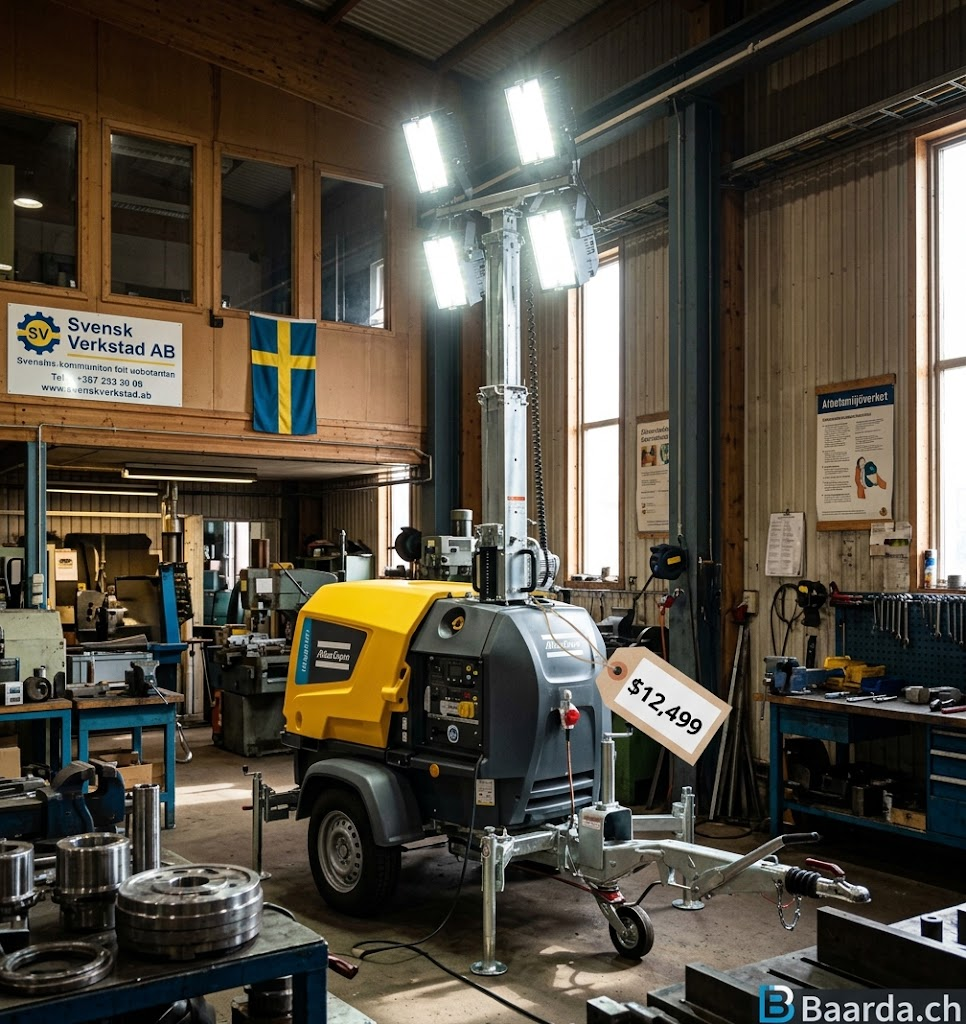
Reint Jelger: So on the image it features a product of Atlas Copco AB the HiLight H7+, could you tell me would companies or consumers order one directly at Atlas Copco AB or would there be retailers? And what is the official website of Atlas Copco AB?
Gemini:
- Commercial & Product Site: atlascopco.com
- Corporate Group & Investor Site: atlascopcogroup.com
Purchasing Channels for the HiLight H7+
Atlas Copco operates a hybrid B2B sales model for equipment in its Power Technique division (generators, light towers, and portable pumps). Individual retail consumers cannot purchase equipment off a store shelf, but commercial clients buy through three main channels:
- Authorized Dealers and Distributors: Local or regional industrial equipment distributors hold inventory for small-to-medium contractors, civil engineering firms, and industrial clients who wish to buy single or small batches of new units.
- Equipment Rental Networks: A substantial portion of light towers flows directly into major equipment rental fleets (such as Loxam, Boels, or United Rentals). Contractors and event organizers frequently rent the HiLight H7+ or purchase pre-owned units from these rental fleets.
- Direct Sales (Atlas Copco Customer Centers): Large enterprise clients, multinational infrastructure developers, mining corporations, and national rental companies deal directly with regional Atlas Copco Customer Centers and specialized sales engineers for custom fleet orders and long-term service contracts.
Reint Jelger: Could you tell me first of all is it true Atlas Copco makes vacuum pumps, and second of all what can you even do with a vacuumpump?
Google Gemini: Yes, absolutely. Atlas Copco is one of the world’s largest manufacturers of vacuum technology. Vacuum Technique is one of the corporation’s four major global business divisions (alongside Compressor Technique, Industrial Technique, and Power Technique). Through their main brand and subsidiaries like Edwards and Leybold, they supply everything from rugged industrial pumps to extreme high-vacuum systems.
What Is a Vacuum Pump Used For?
While a air compressor pushes air into a vessel, a vacuum pump pulls gas molecules out of a sealed space to create negative pressure or a low-pressure environment. This controlled absence of air is critical across many high-tech industries:
- Semiconductor & Electronics Manufacturing: Microchips, solar panels, lithium-ion batteries, and OLED screens are manufactured inside high-vacuum chambers. A single airborne gas molecule or dust particle during chemical vapor deposition or laser etching can ruin an entire silicon wafer.
- Food Packaging & Processing: Vacuum pumps remove oxygen from food packaging (such as coffee bags, meat trays, and dairy) to eliminate bacterial growth and extend shelf life. They are also used in vacuum freeze-drying processes.
- Pharmaceuticals & Chemical Distillation: Lowering pressure lowers the boiling point of liquids. Vacuum pumps allow chemical and pharmaceutical manufacturers to evaporate solvents and dry heat-sensitive drug compounds at low temperatures without scorching or degrading the ingredients.
- Automated Material Handling (Pick-and-Place): Industrial robotic arms use vacuum suction cups to lift, move, and stack delicate items—such as large sheets of architectural glass, cardboard boxes, solar cells, or metal body panels—without clamping or scratching them.
- Composite Molding & Metallurgy: In carbon fiber manufacturing (for aerospace, automotive, or wind turbine blades), vacuum pumps pull all air pockets out of resin molds to prevent air bubbles and ensure structural strength. In steel foundries, vacuum degassing removes trapped gases from molten metal to prevent brittleness.
- Healthcare & Scientific Research: Vacuum systems power hospital suction lines, lab filtration setups, mass spectrometers, electron microscopes, and environmental air sampling tools.
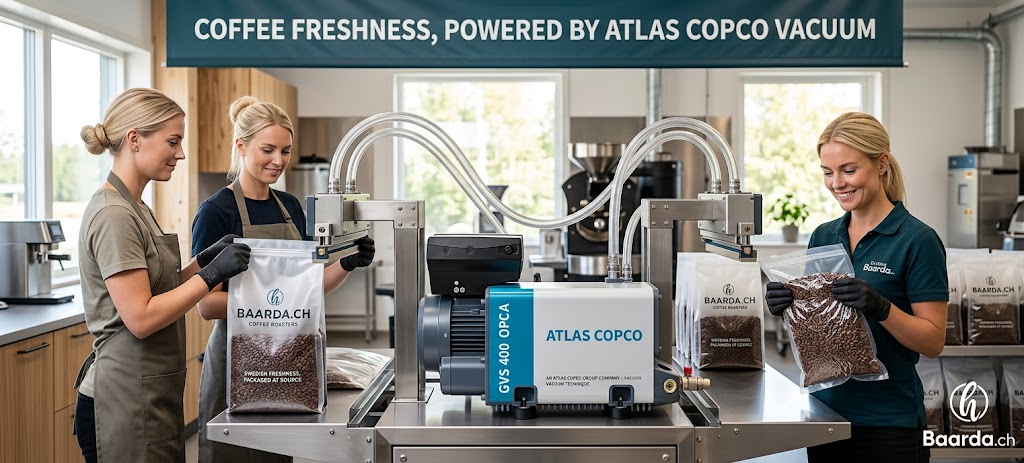
Could you tell me the GVS 400 OPCA is that really an existing product of Atlas Copco Vacuum, how much would one cost, and is it possible baarda.ch has the coffee it will sell vacuumed with a setup as on the image? Thank you, and include 17 paragraphs in Frisian on where BAARDA.CH might import the coffee from if it would like to sell the beans from Switzerland
Product Verification & Pricing
- Does the GVS 400 exist?Yes, but with a slight caveat regarding the image text. Atlas Copco does produce the GVS 400 (specifically the Atlas Copco GVS 400 VSD+), which is a heavy-duty, single-stage oil-sealed rotary vane vacuum pump. However, the letters «OPCA» in the image are an AI text artifact from the image generator attempting to render additional branding text.
- How much does a GVS 400 cost?A brand-new Atlas Copco GVS 400 VSD+ lists for approximately €13,278 EUR (around $14,000 – $15,000 USD), depending on optional accessories, voltage specifications, and regional dealer pricing. Smaller entry-level industrial GVS models (such as the GVS 16 or GVS 40) range from $3,000 to $5,000 USD.
- Is such a vacuum packaging setup feasible for Baarda.ch?Yes, absolutely. In commercial specialty coffee processing, connecting an external industrial vacuum pump to a dual-nozzle chamber sealer or tabletop sealing station is standard practice. Vacuuming coffee bags removes atmospheric oxygen and allows nitrogen flushing before sealing, protecting volatile aromatics and essential coffee oils from oxidation.
Intermission in the Frisian language about where BAARDA.ch could get the coffeebeans from
Hoewol’t Switserlân fanwegen syn alpiene klimaat sels gjin kofjeplanten ferbout, is it lân wol ien fan de wichtichste ynternasjonale knooppunten yn de wrâldwide kofjesektor.
Baarda.ch soe eksklusive kofjebounen ymportearje kinne troch gear te wurkjen mei renommearre Switserske spesjaliteitsbrannerijen (specialty roasters), dy’t de bêste griene bounen ynkeapje en ferwurkje.
In foaroansteande boarne dy’t fia Switserske hannelskanalen beskikber is, is Latyns-Amearika, mei yn ‚t bysûnder de heechlannen fan Kolombia. Kolombiaanske Arabica-bounen steane bekend om har milde, lykwichtige smaak profyl mei toanen fan sûkelade en nuten.
In oare wichtige leveransier yn dizze regio is Brazylje. As de grutste kofjeprodusint ter wrâld leveret Brazylje bounen dy’t in poerbêste basis foarmje foar kofjemelânzjes mei in folle body en in lege soere graad.
Foar leafhawwers fan kompleksere en fruchtige smaakstruktueren kin Baarda.ch kofjebounen helje út Etioopje. Switserske ymporteurs ûnderhâlde faak direkte relaasjes mei Etiopyske kofjeboeren yn ferneamde regio’s lykas Yirgacheffe en Sidamo.
Keniaanske kofjebounen, dy’t faak ferhannele wurde fia de logistike hubs yn Genêve, biede in opfallend smaakprofyl. Mei harren útsprutsen acidity en aroma’s fan swarte beien binne dizze bounen tige sought-after yn it premium segmint.
Midden-Amearika biedt ek Prachtige opsjes, lykas de fulkanyske grûnen fan Guatemala en Kosta Rika. De kofje út dizze regio’s hat faak in ferfinede kompleksiteit dy’t troch Switserske brânpresyzje optimaal ta syn rjocht komt.
Ut Aazje wei kinne Switserske hannelshuzen eksklusive bounen út Yndoneezje leverje, lykas de bekende Sumatryske Mandheling. Dizze kofje hat in krûdige, ierdske smaak dy’t in unike diminsje jout oan it assortimint.
Neist de klassike oarsprongslannen is ek de eksklusive Jamaikaanske Blue Mountain-kofje in mooglikheid. Dit is ien fan de meast meardere kofjesoarten ter wrâld, dy’t faak fia Switserske luxehannelers ferdield wurdt.
Switserlân fungearret as in ynternasjonaal finansjeel en logistyk knooppunt foar de griene kofjehannel. Stêden lykas Genêve en Zug binne thús foar guon fan ‚e grutste hannelsklusters ter wrâld op it mêd fan agraryske grondstoffen.
Dizze Switserske hannelshuzen garandearje in hege mjitte fan kwaliteitskontrôle en duorsumens. Se wurkje meastentiids mei strikte sertifikaten lykas Fairtrade, Rainforest Alliance, en biologyske kwaliteitsmerken.
Wa’t kofje ymportearret fia Switserlân, profitearret fan de Switserske pünktlikens en krektens by it brânen en ferpakken. De bounen wurde faak direkt ferpakt mei stikstof of fakuüm, wat ideaal oanslút by de ferpakkingstechnyk fan Baarda.ch.
De logistike keppeling fan Switserlân nei Fryslân is effisjint en betrouber. Mei it treinferkear en de Jeropeeske snelwegen kinne de farsk brânde bounen fluch yn Fryslân oankomme sûnder kwaliteitsferlies.
Baarda.ch soe in sterk ferhaal bouwe kinne om dizze kofjebounen hinne: de meast selektearre kofje út ‚e kofjegurdle, ferfine troch Switserske presyzje, en ferpakt yn Fryslân foar de regionale merke.
Dit soe perfectly passe binnen it motto Conserve Innove, wêrby’t tradisjoneel ambacht kombinearre wurdt mei ynnovatieve vacuüm- en bewaringstechnologyen.
Troch kofje te selektearjen dy’t fia Switserlân ymportearre wurdt, garandearret Baarda.ch in konstant hege kwaliteitsstandert dy’t foldocht oan de easken fan ‚e meast krityske kofjedrinker.
Uteinlik biedt dit gearwurkingsmodel in poerbêste kâns om in ferskaat oan eksklusive melânzjes oan te bieden dy’t de brêge slaan tusken ynternasjonale topkwaliteit en Fryske ambachtlikens.
That was small insight in the products of Atlas Copco Sweden. Now some investing statistics:
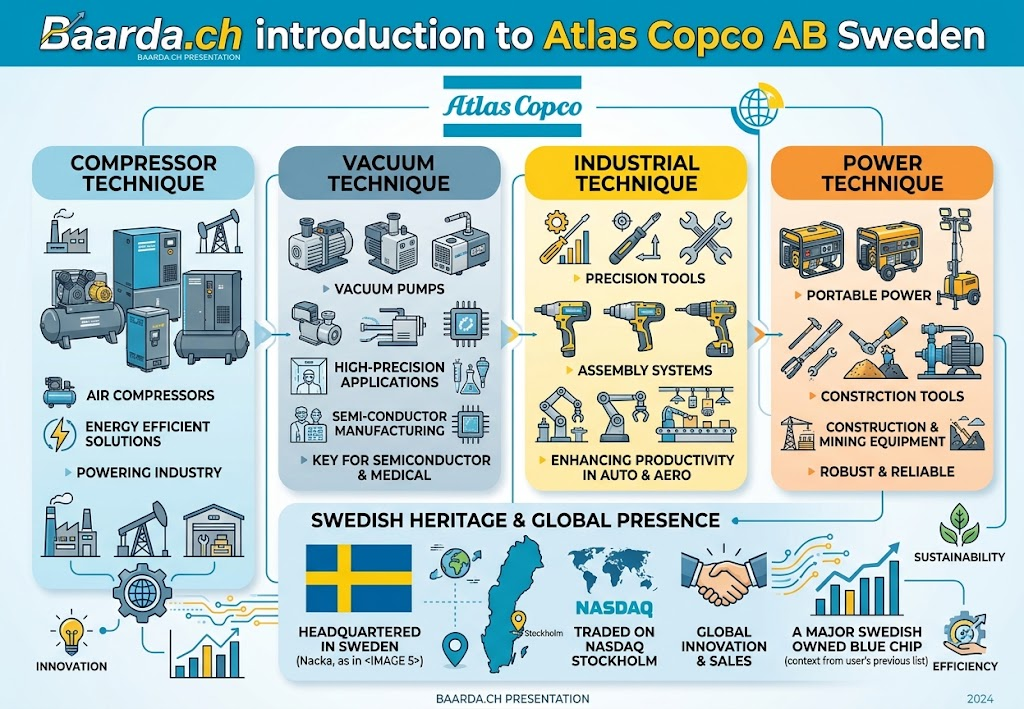
Google Gemini: Atlas Copco AB (listed on Nasdaq Stockholm under tickers ATCO A and ATCO B) represents one of Europe’s most prestigious industrial compounders and a cornerstone of Sweden’s manufacturing heritage. Founded in 1873 and headquartered in Nacka, Stockholm, the company operates as a global leader in sustainable productivity solutions. It is anchored by the Wallenberg sphere through its primary shareholder, Investor AB, which provides long-term strategic alignment and governance stability. For global equity investors, Atlas Copco is widely regarded as a benchmark blue-chip asset combining high capital efficiency, global market leadership, and continuous product innovation.
The operational core of Atlas Copco is structured around four distinct, highly specialized business areas: Compressor Technique, Vacuum Technique, Industrial Technique, and Power Technique. Compressor Technique remains the largest profit engine, delivering air treatment systems and industrial gas compressors worldwide. Vacuum Technique serves high-tech sectors such as semiconductor manufacturing, research laboratories, and flat-panel display production through major sub-brands like Edwards and Leybold. Industrial Technique supplies precision assembly tools, robotics integration, and quality assurance systems to automotive and aerospace manufacturers, while Power Technique delivers mobile generators, dewatering pumps, and light towers. This decentralized divisional structure provides broad sector diversification, insulating overall earnings from cyclical downturns in any single industrial market.
From a financial perspective, Atlas Copco operates at an impressive scale, boasting a market capitalization hovering near $96 billion USD (roughly 1.0 trillion SEK). The group generates annual revenues of approximately $17.5 billion to $18.1 billion USD (SEK 168 billion to 175 billion), backed by annual net profits of roughly $2.75 billion USD. What sets the group apart from traditional machinery manufacturers is its high-margin profitability profile; Atlas Copco consistently delivers gross margins above 42% and operating margins around 21%, demonstrating strong pricing power and tight cost management even during inflationary environments.
Behind this global manufacturing engine is a worldwide team of approximately 56,500 employees. The workforce is distributed internationally across more than 180 countries, reflecting the group’s global footprint. Geographically, roughly 17% of employees are based in South Asia, followed by Western Europe (16%), North America (14%), and East Asia (11%), with its Swedish headquarters retaining core engineering and executive functions. Functionally, about 43% of staff work in operations and logistics, 29% in engineering and R&D, and 28.5% in sales and field service engineering, highlighting a corporate focus on high-margin recurring service contracts.
For fundamental analysts, Atlas Copco’s capital efficiency metrics rank among the best in the global capital goods sector. The firm generates a Return on Invested Capital (ROIC) of approximately 21.0% and a Return on Equity (ROE) of 25.7%, well above industry averages. Furthermore, its Return on Capital Employed (ROCE) exceeds 25%, driven by an asset-light assembly model that relies on specialized suppliers for basic manufacturing while keeping core intellectual property and final assembly in-house. This capital-light framework enables the company to convert operating income into strong free cash flow, which stands at roughly $2.78 billion USD annually.
Shareholder returns remain a core pillar of the Atlas Copco investment proposition, balancing steady dividend payouts with strategic reinvestment. The stock typically offers a dividend yield between 2.4% and 2.8%, supported by a long history of annual dividend increases and periodic capital distribution procedures during cash-rich years. The company maintains a conservative balance sheet with $1.52 billion USD in cash reserves against manageable debt, giving executive management substantial capacity to execute targeted bolt-on acquisitions without over-leveraging the business.
Strategic growth drivers for the company are tied directly to major secular global megatrends: industrial automation, decarbonization, energy efficiency, and semiconductor supply chain expansion. As industrial plants globally face pressure to reduce carbon footprints, Atlas Copco’s variable speed drive (VSD) compressors and energy-efficient vacuum equipment deliver measurable power savings for factory operators. Simultaneously, the global expansion of semiconductor fabrication plants (fabs) drives structural demand for high-purity vacuum systems, connecting the group directly to global microchip manufacturing growth.
Ultimately, investing in Atlas Copco offers exposure to a premier Swedish industrial compounder with strong Wallenberg anchor ownership, disciplined capital allocation, and exposure to high-growth technology markets. While the stock frequently trades at a valuation premium—with an EV/EBITDA ratio around 22x—this multiple is supported by high ROIC, resilient recurring service revenues, and defensive pricing power. For long-term portfolios seeking high-quality European industrial exposure, Atlas Copco remains a benchmark holding capable of compounding value across global economic cycles.