

Gemini: Kongsberg Gruppen ASA sells missiles. Missile systems are one of the flagship business units of their defense division (Kongsberg Defence & Aerospace).
Kongsberg specializes in precision strike cruise missiles:
1. Naval Strike Missile (NSM)
- Type: Long-range, precision anti-ship and land-attack cruise missile.
- Deployment: Fired from naval vessels, coastal defense trucks, or ground launchers.
- Features: Passive infrared seeker, high-subsonic speed, and stealth/sea-skimming capabilities designed to bypass air defense systems.
- Estimated Unit Cost:~$2.2 million to $2.5 million per missile.
- Note: Overall procurement deals (which include launchers, support equipment, integration, and training packages) typically work out to higher effective unit costs.
2. Joint Strike Missile (JSM)
- Type: Air-launched long-range precision strike missile.
- Deployment: Designed specifically to fit inside the internal weapons bays of fifth-generation fighter jets (primarily the F-35).
- Features: Enhanced navigation, land/sea geography mission planning, and high stealth profile.
- Estimated Unit Cost: ~$3.3 million to $3.5 million per missile.
Reint Jelger: another thing that Kongsberg Gruppen ASA Norway sells is Dynamic Positioning technology
Dynamic Positioning (DP) is a computer-controlled technology that allows a ship or floating structure to automatically maintain its position (latitude and longitude) and heading exclusively by using its own thrusters and propellers—without dropping anchors.
It is an incredible feat of marine engineering, essentially acting as an invisible digital anchor.
Dropping physical anchors is impossible or impractical in many modern maritime scenarios:
- Deep Water: In waters thousands of meters deep, heavy anchor chains are structurally unfeasible.
- Environmental Protection: Dropping anchors can destroy fragile marine life and coral reefs.
- Subsea Infrastructure: In crowded oilfields or offshore wind farms, dragging an anchor risks striking expensive underwater cables, pipelines, or wellheads.
- Tight Precision: Operations like laying pipes, positioning wind turbine blades, or keeping a drillship steady over a borehole require millimeter-level accuracy despite rough weather.
How a Kongsberg DP System Works
As a pioneer and market leader in the field, Kongsberg’s DP systems rely on a continuous, closed-loop feedback cycle:
- Sensors Feed the Brain: The vessel is constantly bombarded by external forces—wind, waves, and ocean currents. Sensors (such as high-precision GNSS/GPS, gyrocompasses, wind sensors, and underwater acoustic or laser reference systems) constantly measure the ship’s actual position and environmental conditions. Dynamic Positioning Committee+ 1
- The Mathematical Model (Kalman Filtering): Kongsberg’s software uses advanced algorithms (like Kalman filtering) to combine all this incoming data, filtering out temporary errors (like a wave momentarily tossing a GPS antenna) to predict exact movements. Dynamic Positioning Committee
- The Computer Calculates Thrust: The central computer compares the ship’s actual position against the desired position. If the ship drifts even a meter to the left due to a gust of wind, the computer instantly calculates how much counter-force is needed. Dynamic Positioning Committee
- Thrusters Execute: The system automatically fires the ship’s azimuth thrusters, bow thrusters, and main propellers—modulating power levels up or down and changing angles dynamically to push the ship right back on target.
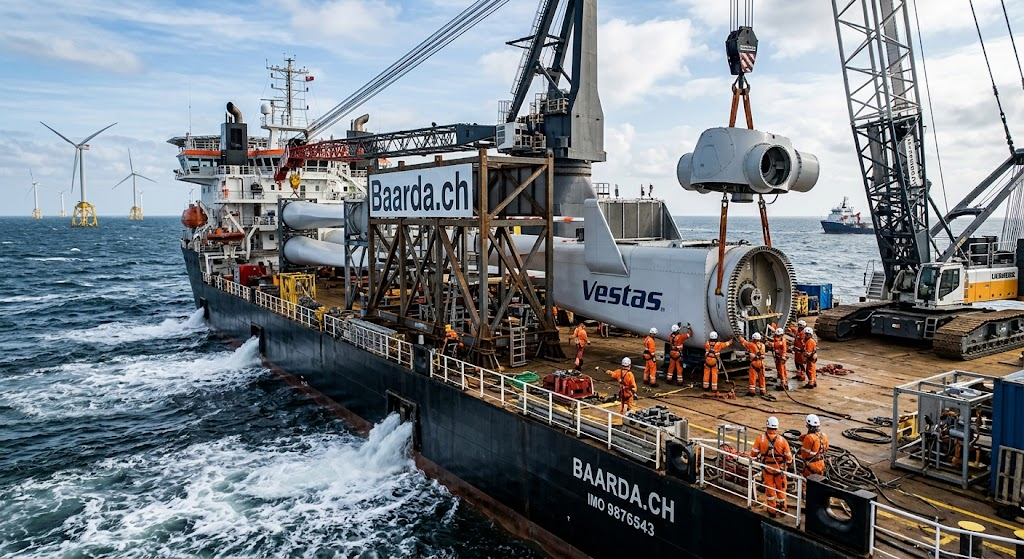
Here is an illustration of a (in this scenario baarda.ch) heavy-lift vessel using its dynamic positioning system to stay completely steady offshore while assembling wind turbine components.
Common Applications
- Offshore Wind Installation: Holding heavy-lift vessels completely steady while technicians assemble massive wind turbine components offshore.
- Cruise Ships: Allowing large passenger liners to «park» close to ports or islands without dropping physical anchors.
- Drillships and Oil Exploration: Keeping multi-billion-dollar drilling rigs locked directly over a wellhead through storms and heavy swells.
- Cable and Pipe Laying: Ensuring miles of undersea fiber-optic cable or steel pipe are laid along a precise geographic track.