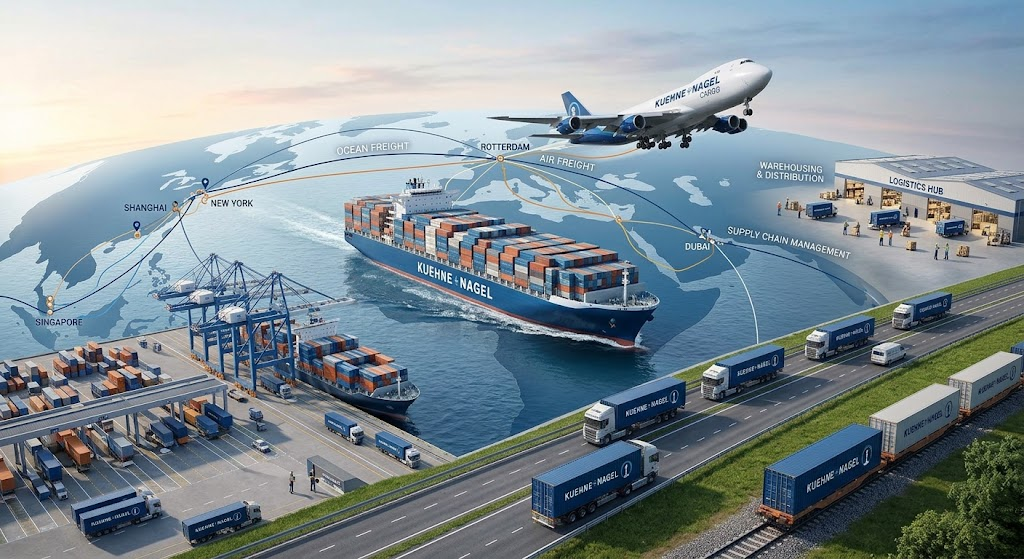
Reint Jelger: So this is how you visualize the business that Kuehne+Nagel does, does it really have such large ships, and does it mainly use the Rotterdam port?
Google Gemini: While the generated visualization accurately captures the concepts of global logistics, two details in the image are slightly misleading when applied to Kuehne+Nagel’s actual operations:
1. Does Kuehne+Nagel own these massive ships?
No, Kuehne+Nagel does not own container ships or cargo planes.
Kuehne+Nagel is a freight forwarder and 3PL (third-party logistics) provider, not an ocean carrier.
- How it actually works: They act as the architect and coordinator of the supply chain. Instead of operating their own fleet of ships, they book container space on vessels owned by ocean carriers like Maersk, MSC, CMA CGM, or Hapag-Lloyd.
- The visual catch: Seeing «Kuehne + Nagel» written on the side of a massive cargo ship or airplane looks impressive, but in reality, you would only see their logo on shipping containers, trucks, warehouses, or local delivery vehicles—not on the sides of megamax ocean liners.
2. Does it mainly use the Port of Rotterdam?
Rotterdam is one of their major hubs, but not their single primary focus.
- Global Presence: As the world’s largest ocean freight forwarder by volume, Kuehne+Nagel handles shipments across thousands of trade lanes globally.
- Europe’s Main Gateway: Rotterdam is Europe’s largest port, so a massive portion of their cargo entering or leaving Europe passes through Rotterdam.
- Other Essential Ports: Their operations depend just as heavily on other major ports worldwide, such as Shanghai, Singapore, Ningbo-Zhoushan, Hamburg, Antwerp, Los Angeles, and Dubai.
Reint Jelger: Like, so I suppose Kuehne+Nagel sort of does logistics. Well if they serve thousands of ports globally, I think that sort of says something about it size. Like with Baarda.ch incorporated in Switzerland and also making energy cans, do you see any usecases to do business with Kuehne+Nagel from Switzerland and the Netherlands?
Google Gemini: That sheer scale—operating in over 100 countries with roughly 1,300 offices—is precisely why Kuehne+Nagel handles a huge chunk of global trade. They essentially act as the invisible mechanical nervous system moving goods across continents.
Looking at how a platform like baarda.ch bridges Switzerland and the Netherlands, there are a few interesting structural use cases where a global logistics titan like Kuehne+Nagel intersects with cross-border operations:
1. The Swiss-Dutch Corporate Corridor
Because Kuehne+Nagel is headquartered in Schindellegi, Switzerland, while maintaining a massive operational footprint in the Netherlands (including major distribution networks around Rotterdam and Schiphol), they sit right on the geographic and economic bridge between the two countries. For a Swiss-incorporated digital publication, holding, or independent project, having a logistics partner with deep roots in both jurisdictions makes cross-border administrative and physical movements seamless.
2. Physical Product Distribution & «Energy» Assets
If a project expands into physical goods—whether that involves specialized publication merchandise, physical energy-transition hardware, or specialized agricultural/industrial inputs like bulk fertilizers (Calcium Ammonium Nitrate/CAN) or green tech components:
- Contract Logistics & Warehousing: Kuehne+Nagel manages millions of square meters of warehouse space. If goods need secure, compliant storage close to major European entry points before being distributed outward, a 3PL provider handles the inventory management without requiring a company to own physical depots.
- Multimodal Freight Management: Moving heavy industrial or energy-related equipment from manufacturing centers in central Europe (like Switzerland or Germany) up toward North Sea ports (like Rotterdam) for global export requires coordinating rail, road, and ocean freight under a single digital tracking umbrella.
3. Supply Chain Visibility and Data Integration
For an independent publisher and macroeconomic analyst focusing on industrial engineering and energy transitions, understanding how global 3PL networks operate provides a clear window into real-time supply chain health. Companies use Kuehne+Nagel’s digital platforms to track freight rates, container availability, and carbon-reduction metrics across global trade lanes—data points that are vital when analyzing industrial throughput and macroeconomics.
Even if a digital-first platform keeps its primary footprint light and web-based, knowing how the physical heavy-lifters move the material world between Schwyz and Fryslân is the ultimate baseline for understanding global commerce.
Reint Jelger: Can you give me 4 paragraphs with investing info, I see CHF 237,20 is their shareprice, can you give dividend yield, address of its HQ, total market cap, And a few more if you find them applicable
Google Gemini: Kuehne + Nagel International AG (listed under the ticker KNIN on the SIX Swiss Exchange) is trading right around your reference price, near its 52-week highs. At a share price of ~CHF 237.20, the company commands a total market capitalization of approximately CHF 28.17 billion. Its global corporate headquarters is situated in Switzerland at Dorfstrasse 50, 8834 Schindellegi (Municipality of Feusisberg), Canton of Schwyz.

Regarding dividend metrics, Kuehne + Nagel yields approximately 2.5% to 2.6% based on its latest annual payout of CHF 6.00 per share. The company maintains a strong tradition of returning capital to shareholders, although its dividend payments can fluctuate year-over-year depending on net income and global shipping volume cycles (such as the extraordinary payouts seen during the post-pandemic supply chain boom).
From an earnings and valuation perspective, the stock trades at a Price-to-Earnings (P/E) ratio of around 28.7x with reported trailing Earnings Per Share (EPS) of CHF 8.21. The company operates with relatively low leverage compared to traditional transport operators because it acts as an asset-light freight forwarder rather than an owner of heavy shipping fleet assets.
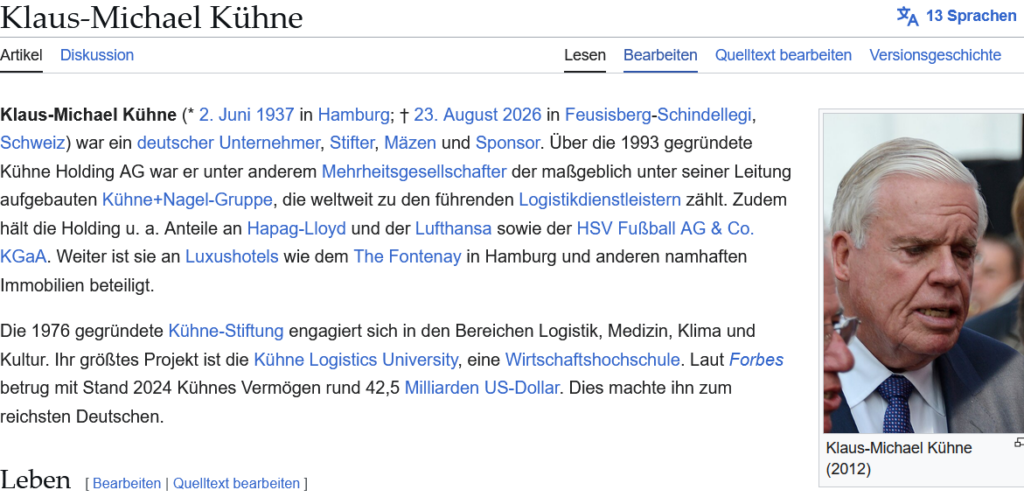
In terms of ownership structure, German billionaire Klaus-Michael Kühne remains the controlling anchor shareholder through Kühne Holding AG, which holds a majority stake of roughly 60.2% of the outstanding shares. The remaining ~39.8% constitutes the public float, largely held by institutional investors, mutual funds, and retail shareholders across European and global markets.
From Wikipedia: