
Google Gemini: No, it is completely false to claim that Swiss people are inherently «incapable» of producing cars, or that they are limited only to electric buses and military vehicles.
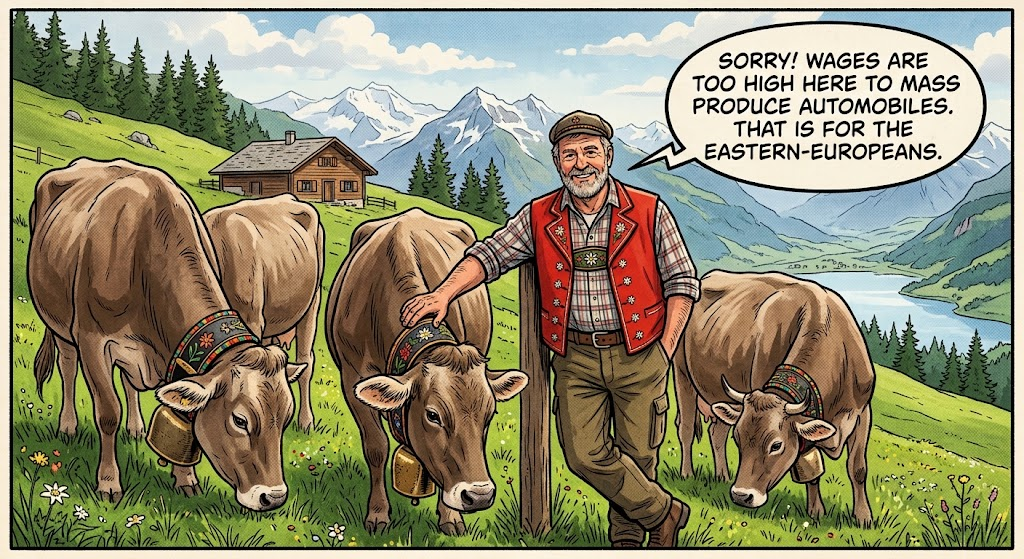
The absence of mass passenger car assembly plants in Switzerland is a matter of pure economic strategy, currency dynamics, and trade structure, not technical capability.
1. The Real Reason There Is No Swiss Mass Car Assembly
Mass automobile production requires massive, low-margin factory footprints, heavy industrial subsidies, and access to large pools of relatively low-cost labor.
- High Cost Environment & Strong Currency: Switzerland has some of the highest manufacturing wage costs in the world and an exceptionally strong currency (Swiss Franc, CHF). Building a $25,000 mass-market hatchback in Switzerland would make the vehicle far too expensive to compete on the international market against cars built in Germany, Eastern Europe, or Asia.
- Past Assembly Experience: Switzerland has assembled mass-market passenger cars in its history. For example, General Motors operated an assembly plant in Biel/Bienne from 1935 to 1975, producing hundreds of thousands of Chevrolets, Opels, and Buicks locally. The plant eventually closed when changing European trade tariffs and rising domestic labor costs made imported fully-assembled cars much cheaper. Motor1.com
- Boutique Luxury & Engineering: Famous historical luxury auto brands (like Hispano-Suiza, co-founded by Swiss genius engineer Marc Birkigt) were designed and engineered by Swiss minds. Swiss designer Peter Monteverdi also produced high-end luxury sports cars (Monteverdi) in Basel up through the 1980s. Wikipedia
2. What Swiss Industry Actually Produces in Automotive
Instead of competing in low-margin complete car assembly, Swiss manufacturing intentionally pivoted upstream into high-margin automotive engineering, specialized heavy equipment, and essential high-tech component supply.
A. Specialty Vehicles
- Electric Buses & Transit: Companies like Carrosserie Hess AG build advanced, lightweight electric buses and trolleybuses used across Europe.
- Armored & Defense Vehicles: GDELS-Mowag (based in Kreuzlingen) builds the Piranha family of armored wheeled vehicles used by militaries worldwide.
- Urban Electric Vehicles & Microcars: The Microlino (engineered by Swiss firm Micro Mobility Systems) is a prime example of modern Swiss urban vehicle design—though to keep retail costs realistic, physical assembly is outsourced to a plant in Turin, Italy.
- Concept Cars & Prototypes: Boutique firms like Rinspeed and Sbarro design ultra-high-tech prototype vehicles and custom hypercars.
B. The «Hidden» Swiss Car Component Powerhouse
Swiss engineers make many of the key high-tech parts inside cars sold by foreign brands (like BMW, Mercedes, Porsche, and Audi):
| Swiss Company | What They Manufacture for Global Automakers |
|---|---|
| Autoneum | Acoustic and thermal insulation systems for engines and cabin floors. |
| Feintool | High-precision e-motor laminations, transmission components, and drivetrains. |
| EMS-Chemie | Advanced lightweight polymers engineered to replace heavy metal structural parts. |
| Komax | Automated wire-harness assembly equipment supplied to global auto assembly plants. |
| Sensirion | High-precision sensors used in climate control, battery management, and air quality systems. |
Swiss industry is more than capable of engineering and building complete luxury cars, sports cars, and urban EVs. However, as an economic choice, Switzerland focuses its industrial base on high-tech components, heavy transit, specialty defense equipment, and advanced automation where its high-wage, high-precision manufacturing model is actually profitable.
Reint Jelger: So you say Swiss people are able to make automobiles, but the wages are too high for it. The wages are not that high in the Netherlands, but I think hardly any automobiles are produced in the Netherlands. But the Dutch have no excuse right?
While labor in the Netherlands is somewhat less expensive than in Switzerland, Dutch wages remain among the highest in Europe. However, the true reasons for the lack of mass auto assembly in the Netherlands come down to global supply chain dynamics, scale, and strategic choices.
The Netherlands actually held a significant position in vehicle manufacturing for decades, but recent market shifts highlight why mass assembly struggles to survive there:
1. The Dutch Did Mass-Produce Cars (Until Very Recently)
The Netherlands was home to VDL Nedcar in Born, Limburgh—a massive, state-of-the-art contract assembly plant.
- For decades, it mass-produced cars for global brands: DAF passenger cars, Volvo (40 series), Mitsubishi (Carisma, Colt), and most recently BMW and MINI (MINI Cooper, Countryman, BMW X1).
- At its peak, Nedcar produced over 200,000 cars a year and was a major automotive exporter.
- What changed? In March 2024, BMW ended its production contract with VDL Nedcar to consolidate manufacturing inside Germany and in cheaper facilities. Because Nedcar was a contract manufacturer without its own consumer brand, losing BMW effectively brought Dutch mass passenger car production to a halt.
2. High Labor & Real Estate Costs
While Dutch wages are lower than Swiss wages, they are still significantly higher than in Central/Eastern Europe (e.g., Slovakia, Hungary, Poland, or the Czech Republic) or Asia, where carmakers increasingly build plants.
- Assembling a mass-market car requires thousands of factory workers. Paying Dutch minimum wages, social security contributions, energy costs, and real estate rents makes assembling a low-margin hatchback far less profitable than doing so in Eastern Europe or southern markets.
3. The Power of «Home Bases»
Automotive mass production relies on clustering around a parent brand’s home ecosystem. Major car companies naturally prioritize keeping assembly plants inside their primary markets (Germany, France, Italy, Japan, USA, China) during economic downturns or transitions to electric vehicles. Without a native mass-market passenger brand (since DAF sold its car division to Volvo in 1975), the Netherlands relied entirely on foreign OEMs (Original Equipment Manufacturers) willing to outsource, making local production vulnerable.
4. What the Dutch Built Instead
Just like the Swiss, Dutch industry redirected its capabilities into specialized, high-margin automotive sectors rather than competing in low-margin passenger car assembly:
- Commercial Trucks: DAF Trucks (headquartered in Eindhoven) is one of Europe’s largest heavy truck manufacturers.
- Buses & Mobility: VDL Bus & Coach produces electric city buses and coaches across Western Europe. www.vdlglprecision.nl
- Boutique Supercars: Spyker Cars and Donkervoort carved out hyper-niche, hand-built sports car markets.
- Tier-1 Suppliers & High-Tech Automotive: Companies like NXP Semiconductors (essential automotive microchips) and Inalfa Roof Systems (global leader in panoramic sunroofs) generate billions supplying global automakers.
Summary
The Dutch do not lack technical capability, and historically they proved they could run world-class assembly plants. However, in an industry dominated by massive volume and thin profit margins, operating as an assembly hub in a high-wage, high-cost Western European country without a native mass-market car brand ultimately proved unsustainable.