
Google Gemini: The conversation around cannabis in Switzerland is currently in a transitional phase. Swiss drug policy has historically focused on harm reduction rather than strict prohibition, and the country is actively evaluating full, regulated adult-use legalization.
Under current Swiss federal law (the Narcotics Act), growing high-THC cannabis at home is not legally permitted.
- The Misconception: The idea that residents can grow 3 plants stems from a famous 2011 intercantonal agreement known as the Latium Concordat (Harmonisierung der Konkordate), signed by several French-speaking cantons (such as Geneva, Vaud, and Neuchâtel). It allowed residents to grow up to 4 plants per person for personal use. However, the Federal Supreme Court of Switzerland struck this down in 2012, ruling that cantons cannot overrule federal narcotics law.
- Current Public Consumption Rules: Consuming high-THC cannabis remains illegal under federal law. However, simple possession of up to 10 grams of high-THC cannabis by adults was decriminalized in 2013 and is treated as a minor administrative infraction, usually subject to an on-the-spot fine of 100 CHF rather than a criminal charge.
- Proposed Legalization (Draft Law): Parliament is actively reviewing a federal framework for adult-use legal cannabis. The parliamentary draft proposes allowing adults to legally grow up to 3 plants per person at home and possess up to 75 grams in private, alongside a licensed retail framework. While approved by key parliamentary committees, this draft law has not yet been enacted into final law. International Cannabis Business Conference+ 1
The presence of pre-rolls, cigarillos, and raw flower at kkiosk, Valora outlets, and gas stations stems from a specific legal threshold established in 2016:
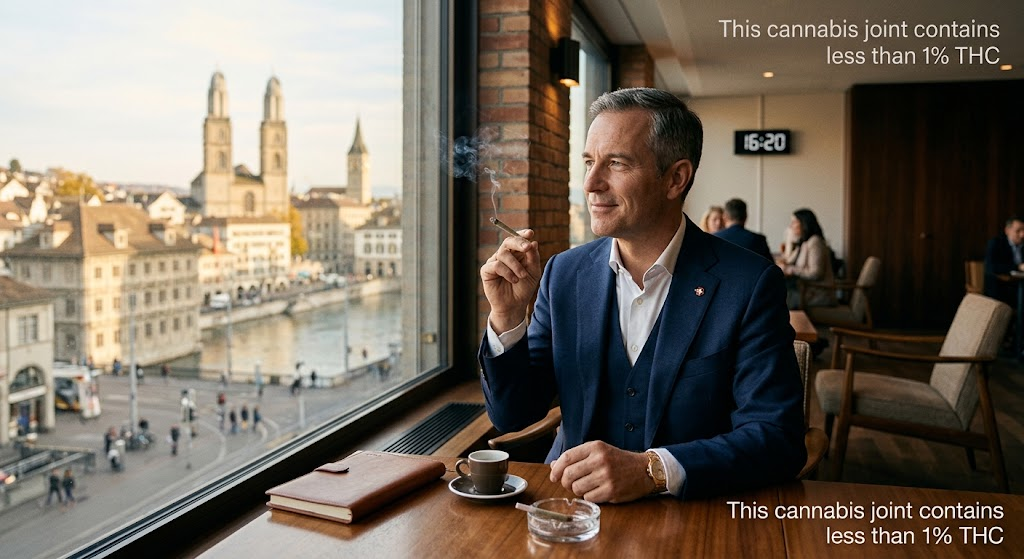
- The 1% THC Threshold: Under Swiss law, cannabis containing less than 1.0% total THC is not classified as a narcotic.
- CBD Products: Because the legal limit in Switzerland (1.0%) is significantly higher than the EU standard (0.2%–0.3%), producers can grow high-CBD cannabis strains with richer terpene profiles and higher CBD percentages while staying strictly under the 1% THC limit.
- Taxation & Regulation: Because low-THC cannabis products (like Al Capone cigarillos containing CBD) are consumed similarly to tobacco, they are regulated and taxed as tobacco substitute products (Tabakersatzprodukte), allowing them to be sold legally across normal retail counters.
To generate scientific data on how a regulated market impacts public health and the illicit market, the Swiss Parliament amended the Narcotics Act to allow controlled scientific pilot trials (Cannabis-Pilotprojekte).
                     SWISS CANNABIS PILOT TRIALS
                                  │
    ┌─────────────────────────────┼─────────────────────────────┐
    ▼                             ▼                             ▼
Basel-Stadt                  City of Zurich                  Lausanne
("WeedCare")                  ("Züri Can")                   ("Cann-L")
   │                             │                              │
Pharmacies &             Specialty Shops &               Non-profit
Specialty Shops             Pharmacies                    Dispensary
- Basel’s «WeedCare» Project: Launched in early 2023 in collaboration with the Department of Health of Basel-Stadt, UPK Basel, and the University of Basel, WeedCare was one of the first trials to sell legal, high-THC cannabis flower, hashish, and vape products to registered adult participants through selected pharmacies and specialty shops.
- How It Works: Participants must be local residents, existing consumers, and registered in the study. The cannabis is organically grown in Switzerland under strict quality standards, with exact THC/CBD ratios labeled and prices set to compete directly with black-market rates.
- Expansion Across Cities: Similar trials are running in Zurich (Züri Can), Lausanne (Cann-L), Geneva, Bern, and Basel-Landschaft.
- Early Results: Initial reports indicate positive health and market outcomes, including a measurable reduction in black-market sales within trial areas and high participant compliance with harm-reduction guidelines. Data from these 3-to-5-year pilot projects is directly shaping the final national legislation.
Erklärung für interessierte Schweizerinnen und Schweizer über Deutschland zur Tolerierung von Cannabis
Google Gemini: Deutschland ist bei der Legalisierung tatsächlich schon einen Schritt weiter als die Schweiz, da es dort bereits einen verbindlichen nationalen Rechtsrahmen gibt. Seit dem 1. April 2024 ist der Umgang mit Cannabis für Erwachsene in Deutschland bundesweit teillegalisiert: Volljährige Personen dürfen legal bis zu 25 Gramm Cannabis in der Öffentlichkeit sowie 50 Gramm zu Hause besitzen und bis zu drei Pflanzen für den Eigenbedarf anbauen. Zudem sind seit Juli 2024 nicht-kommerzielle Anbauvereinigungen („Cannabis Social Clubs“) erlaubt, die ihren Mitgliedern eigenangebautes Gras abgeben dürfen. Der freie Verkauf in regulierten Geschäften oder Kiosken bleibt allerdings auch in Deutschland vorerst verboten; der Erwerb ist somit primär über den Eigenanbau oder die Mitgliedschaft in einem Anbauverein geregelt.