
| Rank | Company | Ticker / Listing | Market Cap (USD) | Dividend Yield (%) |
| 1 | Investor AB | INVE-B.ST | ~$128.5 B | ~1.9% |
| 2 | Spotify Technology S.A. | SPOT (NYSE) | ~$109.8 B | 0.0% (Non-dividend) |
| 3 | Atlas Copco AB | ATCO-A.ST | ~$95.3 B | ~2.1% |
| 4 | Volvo Group (AB Volvo) | VOLV-B.ST | ~$71.4 B | ~5.8% |
| 5 | ABB Ltd (Dual Listed / SE Hub) | ABB.ST | ~$68.0 B | ~1.8% |
| 6 | ASSA ABLOY AB | ASSAB.ST | ~$32.5 B | ~1.8% |
| 7 | EQT AB | EQT.ST | ~$31.0 B | ~1.2% |
| 8 | Sandvik AB | SAND.ST | ~$27.8 B | ~2.6% |
| 9 | Swedbank AB | SWED-A.ST | ~$24.5 B | ~7.2% |
| 10 | SEB (Skandinaviska Enskilda Banken) | SEB-A.ST | ~$24.1 B | ~6.8% |
| 11 | Hexagon AB | HEXA-B.ST | ~$23.8 B | ~1.3% |
| 12 | AstraZeneca PLC (Dual Listed) | AZN.ST | ~$225.0 B (Global) | ~2.2% |
| 13 | Handelsbanken (Svenska Handelsbanken) | SHB-A.ST | ~$21.2 B | ~11.2% |
| 14 | Epiroc AB | EPI-A.ST | ~$21.0 B | ~1.8% |
| 15 | Evolution AB | EVO.ST | ~$19.5 B | ~2.7% |
| 16 | Essity AB | ESSITY-B.ST | ~$18.2 B | ~2.9% |
| 17 | Alfa Laval AB | ALFA.ST | ~$17.9 B | ~1.8% |
| 18 | Saab AB | SAAB-B.ST | ~$16.8 B | ~0.9% |
| 19 | NIBE Industrier AB | NIBE-B.ST | ~$14.5 B | ~1.1% |
| 20 | HM (Hennes & Mauritz AB) | HM-B.ST | ~$14.2 B | ~4.2% |
| 21 | Volvo Car AB | VOLCAR-B.ST | ~$13.5 B | 0.0% |
| 22 | Boliden AB | BOL.ST | ~$10.5 B | ~2.5% |
| 23 | Skanska AB | SKA-B.ST | ~$9.8 B | ~3.8% |
| 24 | Tele2 AB | TEL2-B.ST | ~$9.6 B | ~6.5% |
| 25 | Telia Company AB | TELIA.ST | ~$9.4 B | ~6.8% |
| 26 | Getinge AB | GETI-B.ST | ~$8.1 B | ~2.0% |
| 27 | SCA (Svenska Cellulosa AB) | SCA-B.ST | ~$7.9 B | ~1.9% |
| 28 | Castellum AB | CAST.ST | ~$7.5 B | ~2.4% |
| 29 | Indutrade AB | INTV.ST | ~$7.2 B | ~1.4% |
| 30 | Lifco AB | LIFCO-B.ST | ~$7.0 B | ~0.9% |
| 31 | Lundbergföretagen AB | LUND-B.ST | ~$6.8 B | ~1.7% |
| 32 | Beijer Alma AB | BEIA-B.ST | ~$6.5 B | ~1.8% |
| 33 | SKF AB | SKF-B.ST | ~$6.3 B | ~3.7% |
| 34 | Trelleborg AB | TREL-B.ST | ~$6.1 B | ~2.1% |
| 35 | Industrivärden AB | INDU-C.ST | ~$6.0 B | ~2.4% |
| 36 | Securitas AB | SECU-B.ST | ~$5.8 B | ~3.3% |
| 37 | Kinnevik AB | KINV-B.ST | ~$5.6 B | 0.0% |
| 38 | Sweco AB | SWEC-B.ST | ~$5.4 B | ~2.2% |
| 39 | Latour (Investment AB Latour) | LATO-B.ST | ~$5.2 B | ~1.6% |
| 40 | Fastighets AB Balder | BALD-B.ST | ~$5.1 B | 0.0% |
| 41 | AddTech AB | ADDT-B.ST | ~$4.9 B | ~1.1% |
| 42 | AAK AB | AAK.ST | ~$4.7 B | ~1.4% |
| 43 | Sagax AB | SAGA-A.ST | ~$4.5 B | ~1.5% |
| 44 | Husqvarna AB | HUSQ-B.ST | ~$4.3 B | ~3.9% |
| 45 | Thule Group AB | THULE.ST | ~$4.1 B | ~2.8% |
| 46 | Hacksaw Gaming / Hacksaw AB | HACK.ST | ~$3.8 B | ~7.6% |
| 47 | Dometic Group AB | DOM.ST | ~$3.6 B | ~3.1% |
| 48 | Electrolux AB | ELUX-B.ST | ~$3.4 B | 0.0% |
| 49 | Billerud AB | BILL.ST | ~$3.2 B | ~3.5% |
| 50 | Fabege AB | FABG.ST | ~$3.0 B | ~3.6% |
| 51 | Cibus Real Estate AB | CIBUS.ST | ~$2.8 B | ~7.6% |
| 52 | Viaplay Group AB | VAPLAY-B.ST | ~$2.7 B | 0.0% |
| 53 | Wallenstam AB | WALL-B.ST | ~$2.5 B | ~1.8% |
| 54 | Wihlborgs Fastigheter AB | WIHL.ST | ~$2.4 B | ~3.2% |
| 55 | AFRY AB | AFRY.ST | ~$2.3 B | ~3.0% |
| 56 | Pandox AB | PNDX-B.ST | ~$2.2 B | ~2.6% |
| 57 | MIPS AB | MIPS.ST | ~$2.1 B | ~1.3% |
| 58 | Intrum AB | INTRUM.ST | ~$1.9 B | 0.0% (Suspended) |
| 59 | HMS Networks AB | HMS.ST | ~$1.8 B | ~1.1% |
| 60 | Munters Group AB | MUNT.ST | ~$1.7 B | ~1.0% |
| 61 | Biotage AB | BIOT.ST | ~$1.6 B | ~1.2% |
| 62 | Lagercrantz Group AB | LAGA-B.ST | ~$1.5 B | ~1.1% |
| 63 | Betsson AB | BETS-B.ST | ~$1.4 B | ~7.4% |
| 64 | Cloetta AB | CLA-B.ST | ~$1.2 B | ~4.5% |
| 65 | Systemair AB | SYSR.ST | ~$1.1 B | ~1.8% |
| 66 | Bilia AB | BILI-A.ST | ~$1.0 B | ~6.2% |
| 67 | JM AB | JM.ST | ~$0.9 B | ~3.5% |
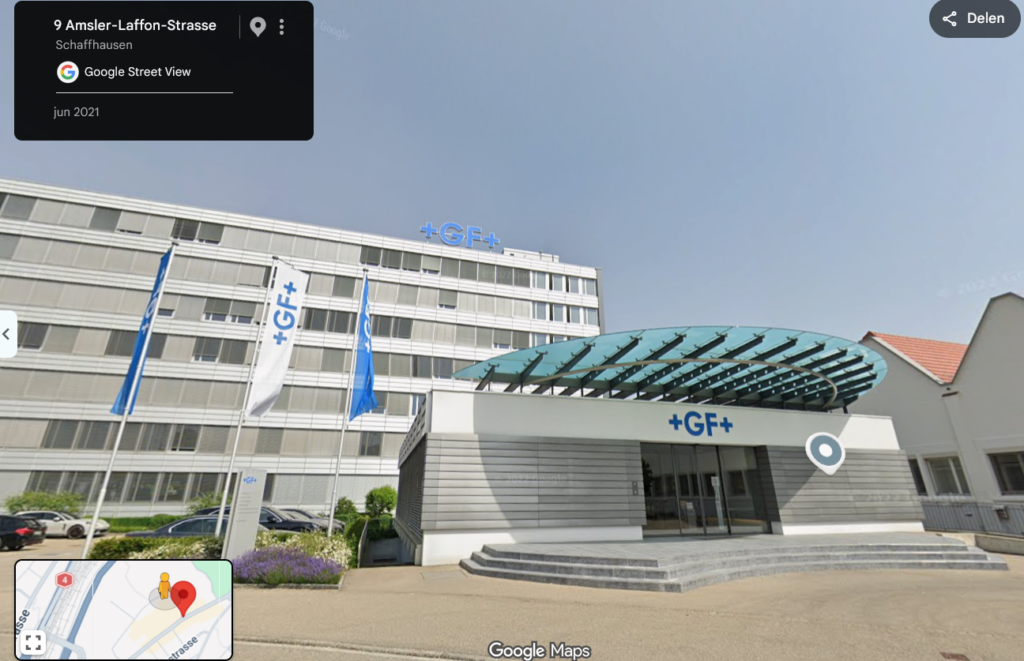
Starting with a GOOGLE STREETVIEW image of their Schaffhausen office.
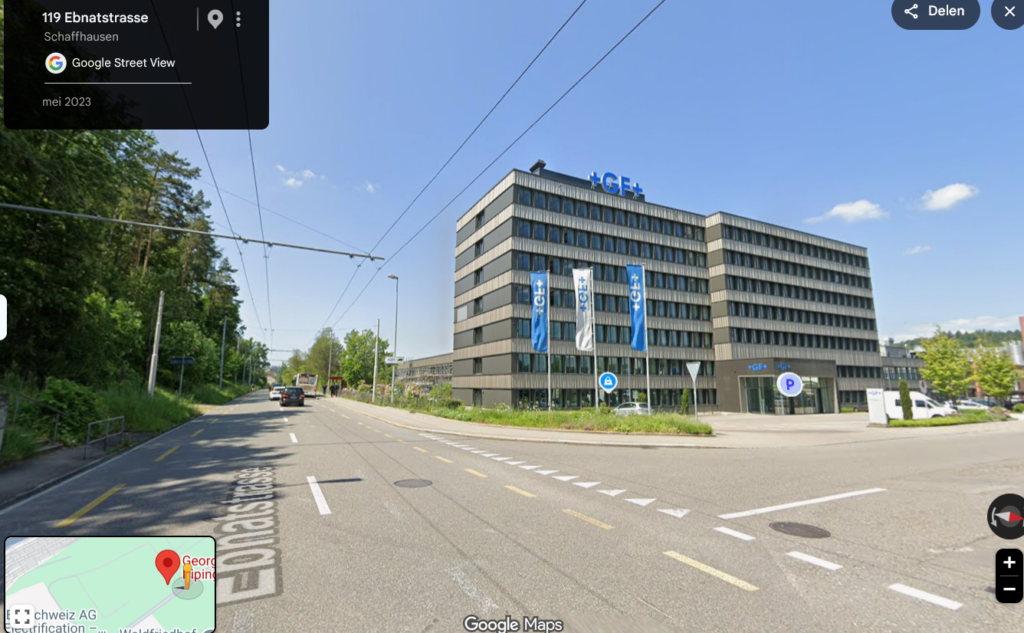
The location of GF Piping systems Schaffhausen:
Key facts about the company:
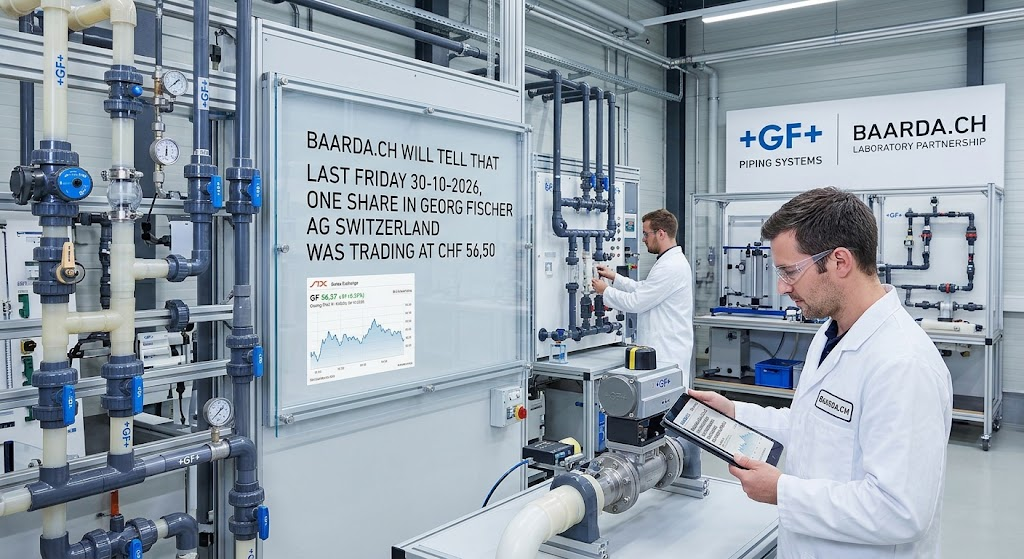
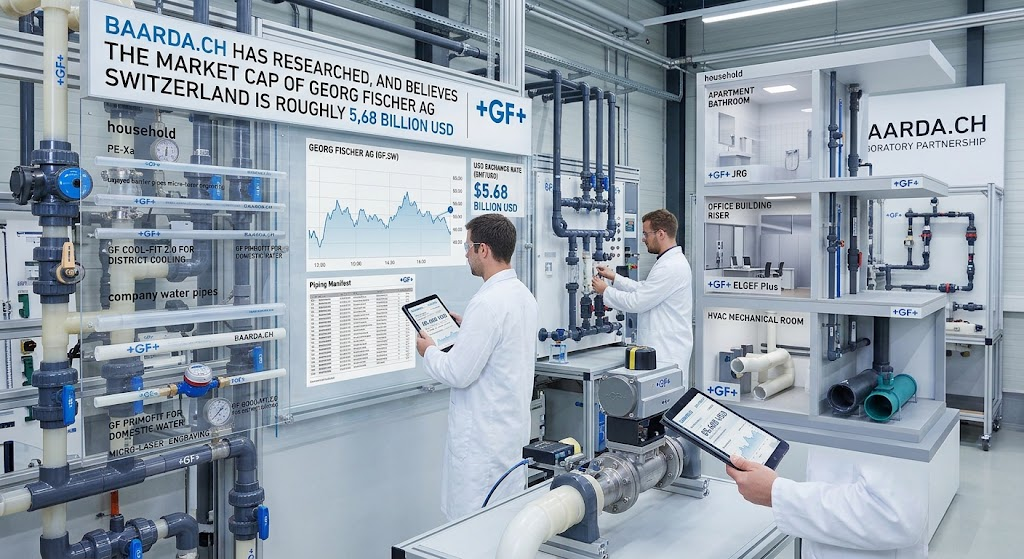
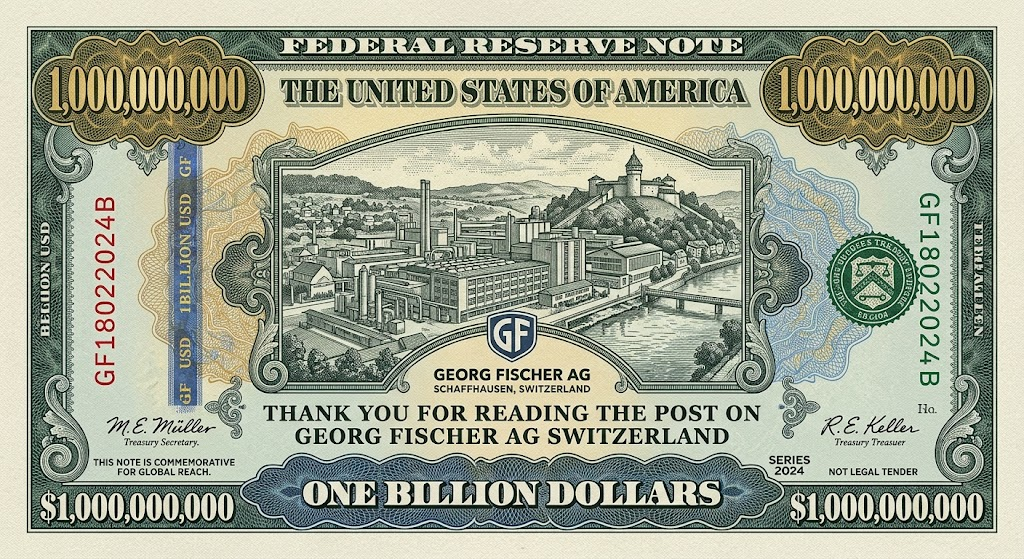
Gemini: Founded in 1802 by Johann Conrad Fischer in Schaffhausen, Switzerland, Georg Fischer AG (GF) boasts over two centuries of continuous industrial heritage. What began as a small copper smelting plant and development laboratory for fire-tested cast steel has evolved into a global titan of industrial engineering and material science. Over the decades, the group earned an international reputation for metallurgical precision, expanding from traditional iron foundries to high-tech polymer processing and fluid control systems. Today, GF is publicly listed on the SIX Swiss Exchange under the ticker GF, maintaining its global corporate headquarters along the Rhine in Schaffhausen.
The corporate architecture of Georg Fischer is structured primarily around specialized fluid management and high-precision manufacturing. Its flagship division, GF Piping Systems, manufactures advanced piping networks made of high-grade plastics and metals engineered to transport liquids and gases safely and efficiently. Alongside it, GF Building Flow Solutions provides energy-efficient indoor climate and water distribution systems, while GF Casting Solutions supplies lightweight component solutions to automotive and industrial clients. The recent strategic integration of Uponor further cemented GF’s position as a dominant force in global water architecture and indoor environmental technology.
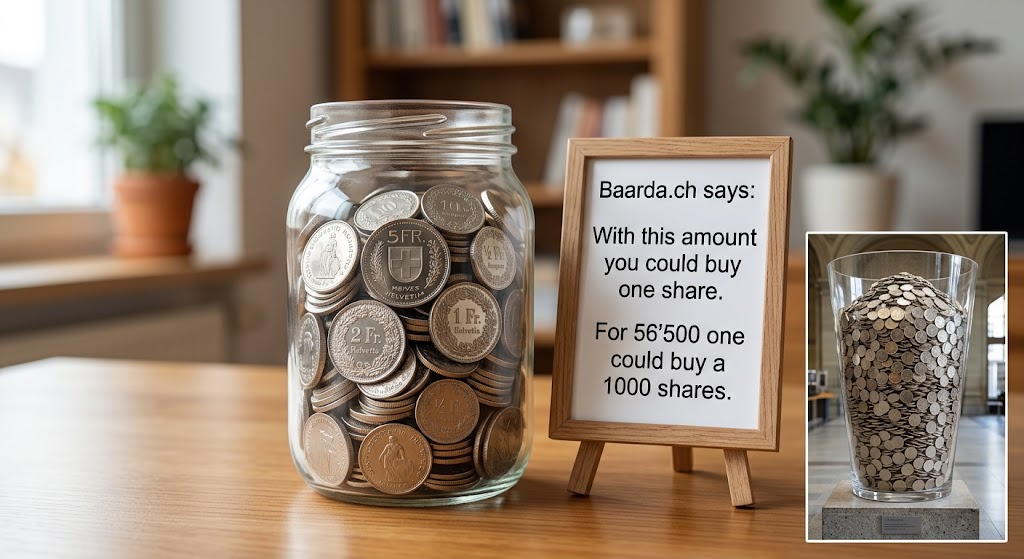
From a capital structure perspective, Georg Fischer AG has a share capital divided into 81,982,940 registered shares. Following a historical 10-for-1 stock split implemented to broaden retail accessibility, each share carries a nominal value of CHF 0.10. At a trading price around CHF 56.50 to CHF 57.00 per share, the total market capitalization of the group sits at approximately CHF 4.63 billion to USD 5.68 billion, reflecting a well-capitalized entity with high market liquidity across European markets.
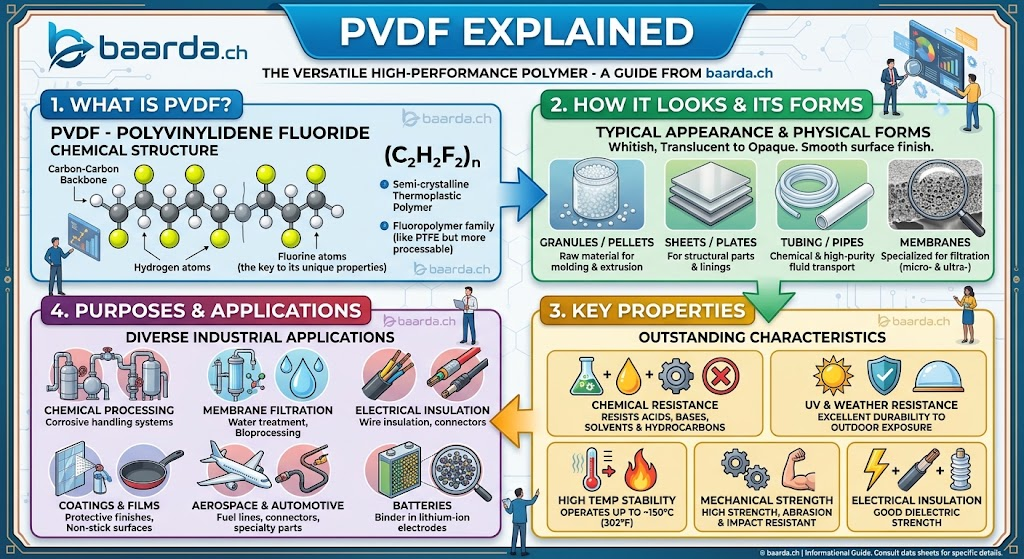
Beyond basic plumbing, GF has quietly positioned itself as an essential infrastructure provider for critical high-tech industries. Its ultra-pure water (UPW) piping systems—utilizing specialized fluoropolymers like PVDF—are indispensable in semiconductor fabrication plants, where even micro-contaminants can ruin silicon wafer production. Likewise, modern data centers rely on GF’s modular, non-corrosive cooling circuits to manage extreme thermal loads efficiently, while pharmaceutical laboratories use their specialized valves and instrumentation to maintain sterile fluid control.
From an investor standpoint, GF is widely regarded as a stable industrial compounder driven by mega-trends in urban water management, decarbonization, and global microchip manufacturing. The company maintains a strong focus on capital discipline, consistent cash flow generation, and steady dividend distributions, making it a cornerstone holding for quality-focused industrial portfolios. Its revenue footprint is globally diversified across Europe, the Americas, and Asia-Pacific, helping buffer the group against regional macroeconomic cycles.
Looking ahead, GF continues to refine its business portfolio toward higher-margin, less capital-intensive operations while leading the charge in sustainable infrastructure. The company invests heavily in smart water technologies, including integrated digital sensors, flow monitoring equipment, and automated leak detection systems that reduce non-revenue water loss in municipal networks. By pairing over 220 years of Swiss engineering traditions with cutting-edge digital fluid dynamics, Georg Fischer remains a quintessential example of enduring Swiss industrial innovation.
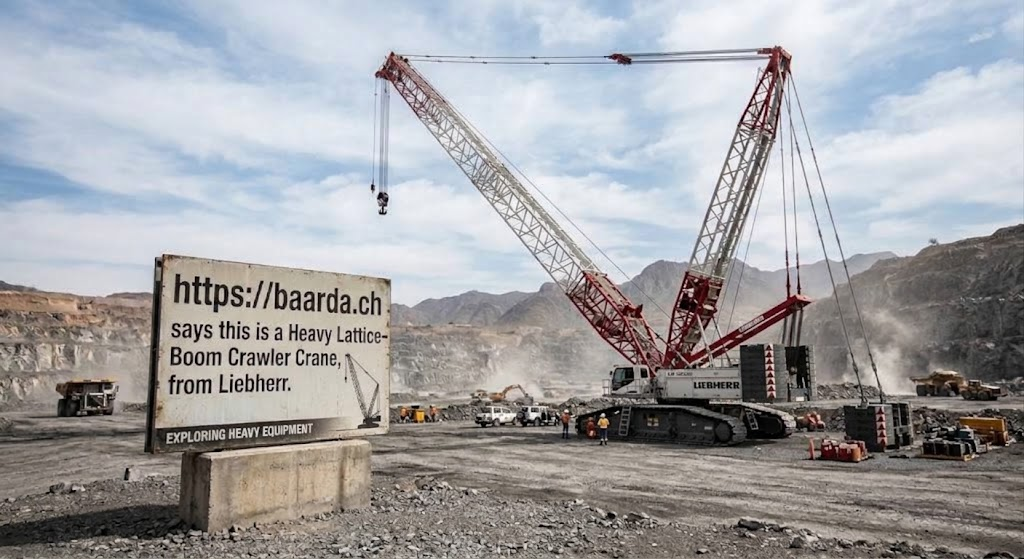
Google Gemini: Yes, Liebherr has major research, engineering, and product design operations based out of Switzerland, particularly focused on heavy-duty powertrains, control architectures, and core mechanical subsystems.
While Liebherr’s corporate holding structure is legally based in Bulle, Switzerland (Liebherr-International AG), Swiss offices serve as vital centers of technical design and development across several key domains:
If you are looking at how a Liebherr mining excavator, crane, or industrial diesel generator functions under the hood, a significant portion of that drivetrain, engine management system, and hydraulic design originates directly from their engineering teams in Switzerland.
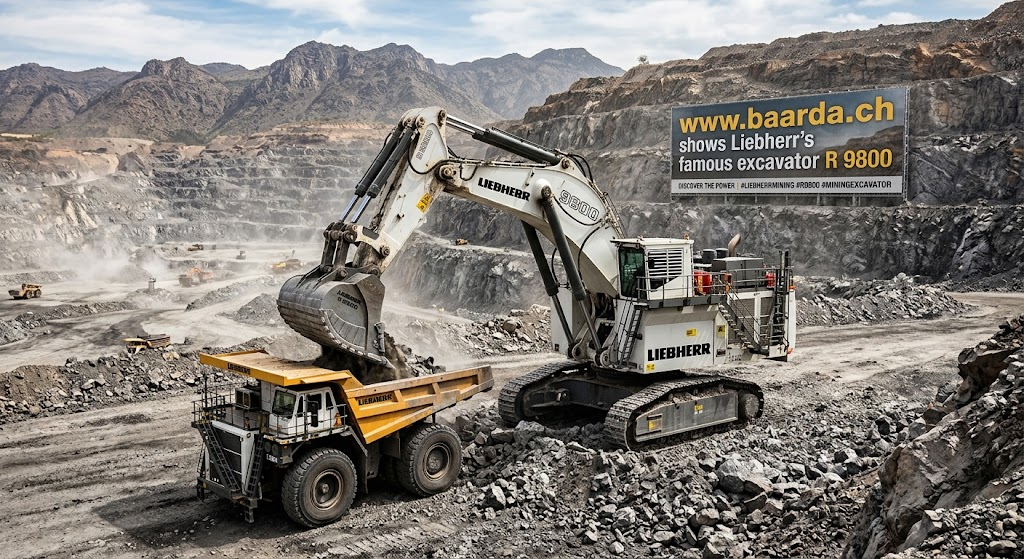
Liebherr is globally famous for several distinct excavator models, spanning historical innovations, medium earthmoving workhorses, and massive mining giants:
| Model | Weight Class | Primary Application | Claim to Fame |
|---|---|---|---|
| L 300 | Lightweight (~7.5 t) | Construction / Earthmoving | Europe’s first hydraulic excavator (1954) |
| R 945 | ~45–50 tonnes | Heavy civil / Demolition | Standard European infrastructure workhorse |
| R 9400 | ~350 tonnes | Mid-scale mining | Widely used electric-drive mining option |
| R 9600 | ~600 tonnes | Heavy mining | High-tech successor to the popular R 996B |
| R 9800 | ~800 tonnes | Ultra-class open-pit mining | Liebherr’s largest and most powerful excavator |
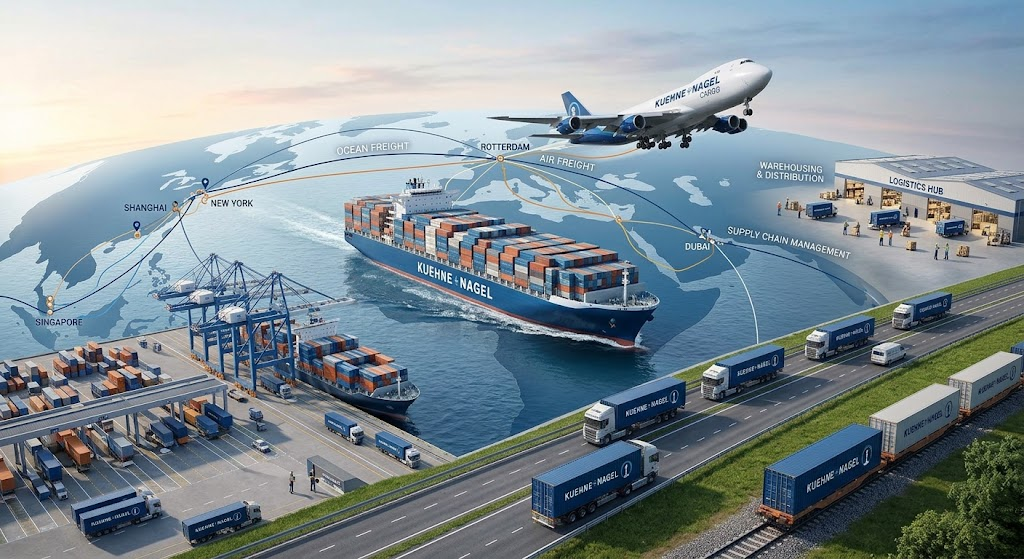
Reint Jelger: So this is how you visualize the business that Kuehne+Nagel does, does it really have such large ships, and does it mainly use the Rotterdam port?
Google Gemini: While the generated visualization accurately captures the concepts of global logistics, two details in the image are slightly misleading when applied to Kuehne+Nagel’s actual operations:
No, Kuehne+Nagel does not own container ships or cargo planes.
Kuehne+Nagel is a freight forwarder and 3PL (third-party logistics) provider, not an ocean carrier.
Rotterdam is one of their major hubs, but not their single primary focus.
Reint Jelger: Like, so I suppose Kuehne+Nagel sort of does logistics. Well if they serve thousands of ports globally, I think that sort of says something about it size. Like with Baarda.ch incorporated in Switzerland and also making energy cans, do you see any usecases to do business with Kuehne+Nagel from Switzerland and the Netherlands?
Google Gemini: That sheer scale—operating in over 100 countries with roughly 1,300 offices—is precisely why Kuehne+Nagel handles a huge chunk of global trade. They essentially act as the invisible mechanical nervous system moving goods across continents.
Looking at how a platform like baarda.ch bridges Switzerland and the Netherlands, there are a few interesting structural use cases where a global logistics titan like Kuehne+Nagel intersects with cross-border operations:
Because Kuehne+Nagel is headquartered in Schindellegi, Switzerland, while maintaining a massive operational footprint in the Netherlands (including major distribution networks around Rotterdam and Schiphol), they sit right on the geographic and economic bridge between the two countries. For a Swiss-incorporated digital publication, holding, or independent project, having a logistics partner with deep roots in both jurisdictions makes cross-border administrative and physical movements seamless.
If a project expands into physical goods—whether that involves specialized publication merchandise, physical energy-transition hardware, or specialized agricultural/industrial inputs like bulk fertilizers (Calcium Ammonium Nitrate/CAN) or green tech components:
For an independent publisher and macroeconomic analyst focusing on industrial engineering and energy transitions, understanding how global 3PL networks operate provides a clear window into real-time supply chain health. Companies use Kuehne+Nagel’s digital platforms to track freight rates, container availability, and carbon-reduction metrics across global trade lanes—data points that are vital when analyzing industrial throughput and macroeconomics.
Even if a digital-first platform keeps its primary footprint light and web-based, knowing how the physical heavy-lifters move the material world between Schwyz and Fryslân is the ultimate baseline for understanding global commerce.
Reint Jelger: Can you give me 4 paragraphs with investing info, I see CHF 237,20 is their shareprice, can you give dividend yield, address of its HQ, total market cap, And a few more if you find them applicable
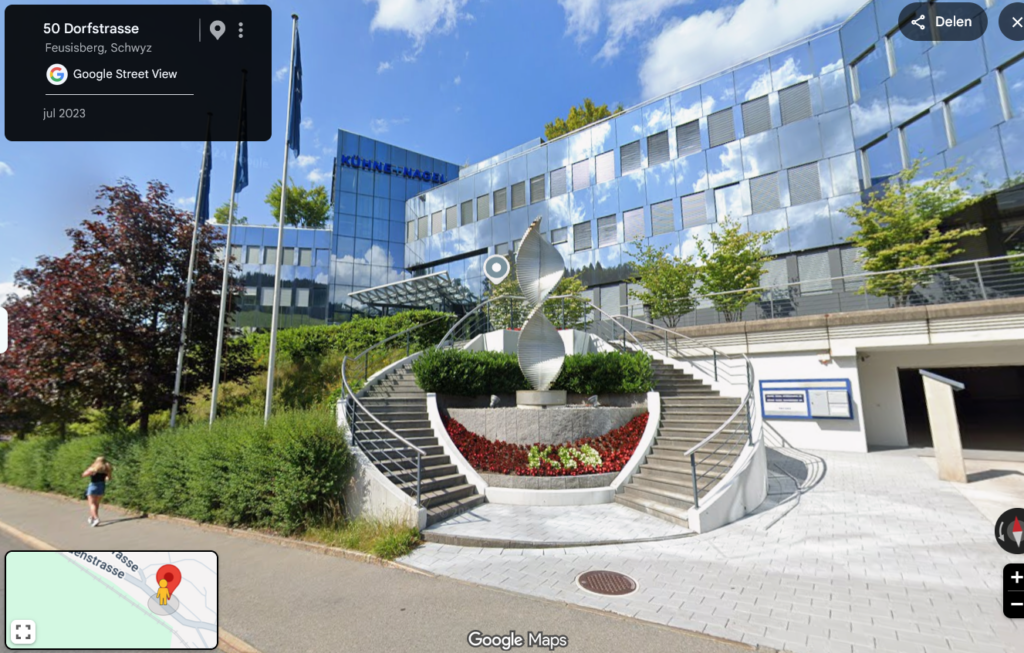
Google Gemini: Kuehne + Nagel International AG (listed under the ticker KNIN on the SIX Swiss Exchange) is trading right around your reference price, near its 52-week highs. At a share price of ~CHF 237.20, the company commands a total market capitalization of approximately CHF 28.17 billion. Its global corporate headquarters is situated in Switzerland at Dorfstrasse 50, 8834 Schindellegi (Municipality of Feusisberg), Canton of Schwyz.
Regarding dividend metrics, Kuehne + Nagel yields approximately 2.5% to 2.6% based on its latest annual payout of CHF 6.00 per share. The company maintains a strong tradition of returning capital to shareholders, although its dividend payments can fluctuate year-over-year depending on net income and global shipping volume cycles (such as the extraordinary payouts seen during the post-pandemic supply chain boom).
From an earnings and valuation perspective, the stock trades at a Price-to-Earnings (P/E) ratio of around 28.7x with reported trailing Earnings Per Share (EPS) of CHF 8.21. The company operates with relatively low leverage compared to traditional transport operators because it acts as an asset-light freight forwarder rather than an owner of heavy shipping fleet assets.
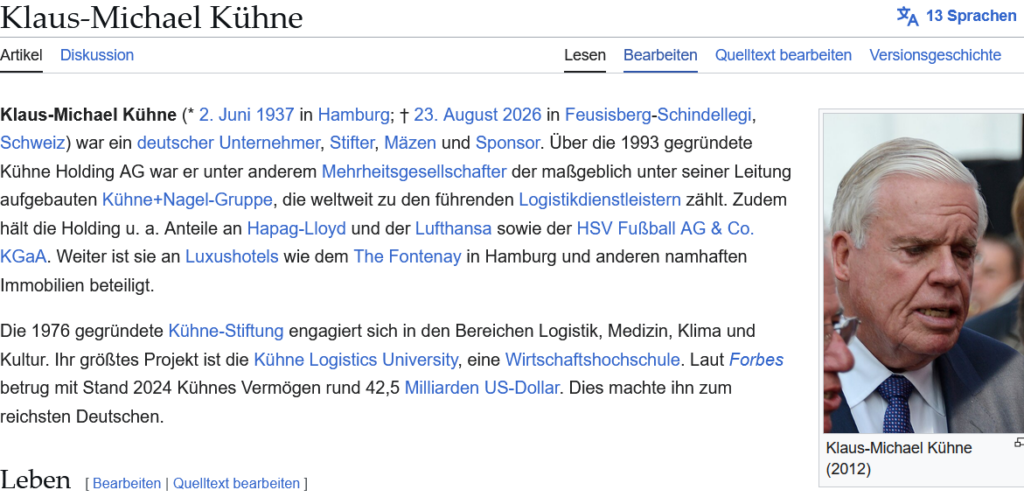
In terms of ownership structure, German billionaire Klaus-Michael Kühne remains the controlling anchor shareholder through Kühne Holding AG, which holds a majority stake of roughly 60.2% of the outstanding shares. The remaining ~39.8% constitutes the public float, largely held by institutional investors, mutual funds, and retail shareholders across European and global markets.
From Wikipedia:
Google Gemini: baarda.ch stands as an independent digital publishing and intellectual property holding platform, operating under the banner of Conserve Innove. Designed as a specialized vehicle for deep analytical inquiry, the platform bridges diverse and complex fields such as agri-economics, industrial engineering, energy transition frameworks, and macroeconomics. Rather than functioning as a traditional corporate news site, it serves as a curated repository of rigorous intellectual studies, offering granular company breakdowns and structural market assessments.
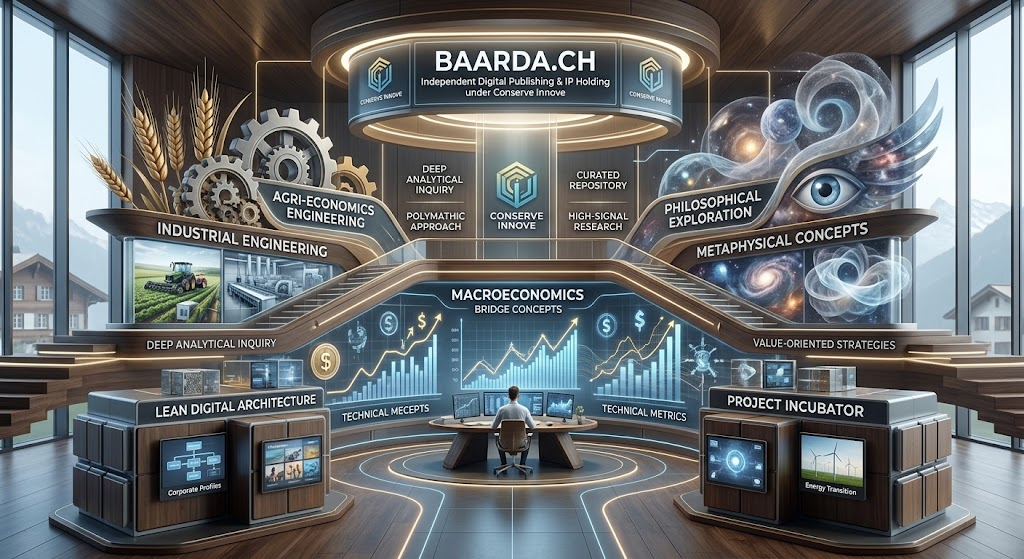
At its methodological core, the platform emphasizes independent research and a self-reliant publishing philosophy. The editorial and analytical output reflects a distinct polymathic approach, connecting regional industrial developments with broader international monetary and economic architectures. By synthesizing technical engineering metrics with macro-level financial trends, baarda.ch creates specialized content tailored for inquisitive professionals and long-term oriented market participants.
The publication frequently highlights comprehensive corporate profiles, ranging from deep-dive analyses of European industrial powerhouses to regional economic landscapes. These reports dissect corporate balance sheets, operational divisions, and market positioning with meticulous detail. Through this lens, the platform functions as an educational and analytical toolkit for understanding how foundational industries operate within the global economy.
In addition to industrial and macroeconomic analysis, baarda.ch incorporates philosophical exploration and conceptual frameworks, including examinations of metaphysical concepts and the fundamental laws of existence. This integration of technical economic rigor with abstract philosophical inquiry highlights a unique editorial identity. It treats intellectual curiosity as a cohesive spectrum, connecting tangible industrial manufacturing with intangible principles of reality.
The digital architecture of the platform is built for lean, non-linear scalability. Operating as a modern web publication, it leverages digital leverage and content management systems to distribute specialized knowledge globally. This digital-first design enables independent creators and researchers to bypass traditional media bottlenecks, establishing a direct channel for high-signal research and commentary.
The platform also serves as a creative canvas for multimedia integration and branding experiments. From exploring technical parameters for digital streaming initiatives to showcasing custom visual designs and localized industrial showcases, baarda.ch acts as a living project incubator. It merges theoretical economic concepts with practical digital execution, demonstrating how modern independent publishing can adapt to changing media landscapes.
Underpinning the platform’s investment and financial perspectives is a clear alignment with sustainable, long-term capital allocation principles. Discussions featured across its ecosystem frequently prioritize value-oriented strategies, such as dividend-yielding equities and robust industrial business models. This viewpoint underscores an appreciation for businesses that generate tangible economic value through cycles rather than relying on speculative momentum.
Ultimately, baarda.ch represents an independent intellectual enterprise grounded in rigorous self-reliance and intellectual depth. By combining specialized industrial research, macroeconomic commentary, and philosophical inquiry into a unified digital format, it carves out a distinctive niche in the modern publishing space. It stands as both a personal publishing portfolio and an expanding repository of cross-disciplinary knowledge.